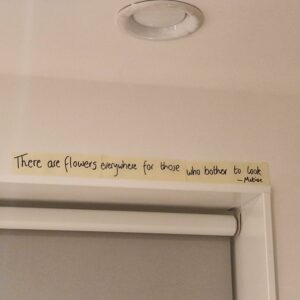
The World in A Phrase at the Harvard Kennedy School

Thanks to my colleagues in the Harvard Kennedy School’s Communications Program for inviting me to do a talk on political aphorisms. From the form’s beginnings in ancient China and Egypt, aphorisms have always been about governing — how to govern the self, the state, society. In Egypt, rulers like Ptah-Hotep set down collections of aphorisms to be used as moral instruction manuals for the sons who would inherit their kingdoms…

He that obeys becomes one obeyed.

In China, the I Ching is a book of governance, and in the Tao te Ching Lao Tzu has lots to say about how best to govern a country or community…

Ruling a large kingdom is like cooking a small fish; the less handled the better.

Muhammad ibn Zafar Al-Siqilli was known in his lifetime as “The Sicilian Wanderer” because he left his native Sicily to roam the Maghreb searching for an Arab prince who would put his political teachings into practice. He didn’t have much luck. After traveling back and forth between Sicily and northern Africa, al-Siqilli finally settled in Syria, where he died in poverty and without an official position. Al-Siqilli’s story has much in common with those of Confucius and Machiavelli: All three sought and failed to achieve influential positions at court, and both al-Siqilli and Confucius lived the latter parts of their lives as itinerant sages in search of like-minded monarchs. Al-Siqilli had some important insights about political policy makers and policy advisors…

Counsel is the mirror of the intellect. If, therefore, you would like to know the capacity of anyone, ask for their advice.

Madame De Staël was also a great political aphorist:

When one does not know how to convince, one oppresses

as was Audre Lorde:

In our world, divide and conquer must become define and empower.

One professional category is conspicuously underrepresented in the history of the political aphorism — politicians themselves. That is no doubt because aphorisms are too provocative and confrontational for campaigning, when candidates are likely to opt for poetry, then of course reverting to non-aphoristic prose for governing. Two notable exceptions are Benjamin Disraeli, who twice served as British Prime Minister and helped create the modern British Conservative Party (on becoming Prime Minister, he observed: “I have climbed to the top of the greasy pole”):

The palace is not safe when the cottage is not happy

and Adlai Stevenson, who lost both the 1952 and 1956 presidential elections to Dwight D. Eisenhower. Eisenhower, in fact, used to tease Stevenson about the witty aphorisms he included in his speeches, and Stevenson replied, “I refuse to conform to the Republican law of gravity.” Stevenson’s aphorisms are still wickedly smart and apt today:

The hardest thing about any political campaign is how to win without proving that you are unworthy of winning.

If the Republicans stop telling lies about us, we will stop telling the truth about them.

Sometimes in the deafening clamor of political salesmanship, I’ve thought that the people might be better served if a party purchased a half hour of radio and TV silence during which the audience would be asked to think quietly for themselves.

After a whirlwind tour of 5,000 years of political aphorisms, the HKS group went into aphorism-writing mode, penning some astute sayings of their own…

From the tomb of Troy came the cradle of Rome. —Muneeb Ata

Even the Ivy League grows weeds. —Alison Kommer

When you go far enough everything is on the way back. — Surbhi Bharadwaj

This past summer Surbhi and some of her friends began spontaneously composing aphorisms, including the one above, and recording them on video. The video shows the political nature of the aphorism in its purest form. The word ‘political’ comes from the Greek polites, meaning ‘citizen’, which in turn comes from polis, meaning ‘city-state’. Like politics, aphorisms pertain to public life and governance in three main ways:

  • They are a popular, grass-roots form — of the people, by the people, for the people — composed by citizens much more often than they are composed by political leaders
  • They are part of the tradition of persuasive rhetoric, like the shortest possible political policy memo, devised as solutions to shared problems, challenges, or opportunities
  • They are originally oral and often delivered in public, like the shortest possible political speech

Check out Surbhi and co.’s aphorism mash up vid below!

20250700 Emily + Surbhi Aphorisms


This week in The World in A Phrase III

Vladimir Putin is out with his latest annual calendar, which attempts to portray the Russian dictator in various manly, domestic, and statesmanlike settings. Each page of the calendar is accompanied by an attempt to portray the Russian dictator saying some vaguely manly, domestic, and statesmanlike thing, such as this oblique reference to Putin’s barbaric war against Ukraine: “Russia’s border never ends.” More accurate would be to accompany each picture with an aphorism from William Ralph Inge, dean of St. Paul’s Cathedral in London from 1911 until his death in 1954, such as these…

A man may build himself a throne of bayonets, but he can’t sit on it.

A nation is a society united by a delusion about its ancestry and by common hatred of its neighbors.

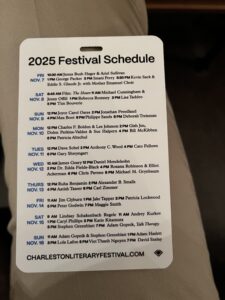
While at the Charleston Literary Festival, I visited the International African American Museum, located on the site of Gadsden’s Wharf, the arrival point in the U.S. for as many as 100,000 enslaved Africans. There I saw one of the stoneware jugs made by the enslaved potter David Drake. During the time Drake was at work in Edgefield, South Carolina, an area known for its stoneware, literacy was illegal for enslaved people. So it was a remarkable and dangerous act of defiance for him to write on his jars and jugs. He did it anyway, adding aphoristic couplets on moral, spiritual, and practical themes to his vessels.

Give me silver or; either gold

though they are dangerous; to our soul


I wonder where is all my relations

Friendship to all – and every nation

While in DC for a talk at Politics and Prose, I dropped by the Phillips Collection, where I sat in the Rothko room for a rumination and also spotted “Girl Writing” (1941) by Milton Avery, a poignant depiction of the composition process…


3 more podcasts featuring The World in A Phrase

Here are three more recent podcasts about all things aphoristic, with some conversation highlights indicated by time signatures… Once again I’m grateful for the chance to talk about The World in A Phrase on these wonderful podcasts and thank the hosts for their close readings and fun, provocative questions.

On The Spectator Book Club Podcast, the conversation with host Sam Leith covered everything from why aphorisms are like intellectual puzzles (3:24-5:34) to how aphorists stay lighthearted through dark humor (27:25-32:06) to key female aphorists in the history of the form (30:35-32:06)

On Lit with Charles, host Charles Pignal and I talked about What Walden means to me — and to the history of the aphorism — and why Henry David Thoreau is still relevant today

How James Joyce’s idea of the epiphany is related to aphorisms and how realizing Ulysses was funny helped me finally understand the book

Why some aphorisms work without words

On The Decision-Making Studio Podcast, with host Ben Cattaneo, we explored aphorisms as heuristic devices (9:21-14:09), aphorisms as decision-making manuals (20:22-24:32), aphorisms and improvisation via Wynton Marsalis (32:58-34:53), and what thinking aphoristically means to me (1:03:10-1:04:12)

3 podcasts featuring The World in A Phrase

I’m grateful for the chance to talk about The World in A Phrase on some wonderful podcasts, ranging widely in their focus — from heuristics to philosophy to linguistics. Here are three recent podcasts about all things aphoristic, with some conversation highlights indicated by time signatures…

On From Nowhere to Nothing, a podcast looking at abstract ideas and cultural issues with a down-to-earth demeanor and willingness to explore, I talked with hosts Joel Bouchard and Norman Gayford about, among other aphoristic matters …

Why aphorisms are novellas in sentence form (10:06-12:42)

Aphorisms as provocations that elicit that all-important philosophical “hmm…” (21:58-24:52)

Metaphysical fables and koans as aphorisms (29:20-30:31)

On Linguistically Aware, about all things linguistics from the University of Calgary campus radio station, I talked with host Brooklyn Sheppard about …

Aphorisms as holograms (17:40-18:45)

Why the most difficult thing to find is the way to signposts (33:46-38:03)

How life consists of what a person is thinking of all day (39:54-41:48)

On the Human Risk podcast, which explores human risk and how to mitigate it, I talked with host Christian Hunt about …

Why aphorisms are joyful (12:03-14:32)

The aphorism “A hero is no braver than an ordinary person…” (26:22-28:20)

How the Ukrainian government uses aphorisms as memes (37:32-40:34)

Why aphorisms are not a highbrow art form (53:29-56:03)

AI and aphorisms as prompts (56:42-1:01:56)

What’s the difference between an aphorism and a …

… is a question often heard when talking about how to define an aphorism and distinguish it from all the other kinds of short sayings out there. So, if my 5 Laws of the Aphorism do not suffice, here’s a handy field guide to spotting the difference between an aphorism and a …

What is the difference between an aphorism and an adage?
An adage is a variation on a proverb and feels slightly hackneyed. An aphorism is always fresh.

What is the difference between an aphorism and an apothegm?
An apothegm is an anecdote, usually concerning historical persons and often set in antiquity, which may or may not have an aphorism as its punchline.

What is the difference between an aphorism and an axiom?
An axiom is a self-evident proposition, usually on which an argument or theory is based. An axiom must be true, or at least believed to be true. Aphorisms can contradict each other.

What is the difference between an aphorism and a bromide?
Potassium bromide is used in medicine as a sedative. Literary bromides have the same effect.

What is the difference between an aphorism and a dictum?
A dictum is meant to settle an issue or pronounce a verdict. An aphorism incites debate.

What is the difference between an aphorism and an epigram?
Epigrams usually rhyme, are often funny and cynical, and are always intended to castigate or criticize a rival. When they are also philosophical, they are aphorisms.

What is the difference between an aphorism and an epithet?
An epithet is a nickname, or a descriptive phrase characteristic of a particular individual. While an aphorism is also specific, its application can be extended to encompass groups — of people, things, or situations.

What is the difference between an aphorism and an euphemism?
A euphemism is a clever, delicate phrase that expresses what you mean without actually saying it; an aphorism says exactly what you mean in precisely those words that best express it.

What is the difference between an aphorism and an euphuism?
Euphuism is a term used to describe the ornate, embellished, verbose style of Elizabethan writers like John Lyly. A euphuism is typically overly-long but also strangely beautiful. If you took a page of euphuistic prose, brought it to a low boil, and let it simmer overnight, you would wake up with an aphorism.

What is the difference between an aphorism and a fragment?
A fragment is a piece of writing that is, deliberately or involuntarily, left unfinished. An aphorism is complete in itself, the first (or last, per Marie von Ebner-Eschenbach) link in a long chain of thought.

What is the difference between an aphorism and a haiku?
A haiku is impressionistic, imagistic, usually leaving an emotion or feeling rather than a thought in its wake. An aphorism, while often deploying startling imagery, always provokes thought in addition to emotion and feeling.

What is the difference between an aphorism and an idiom?
An idiom is a short metaphorical expression that cannot be understood through a literal interpretation of its constituent words; e.g. He “kicked the bucket.” An aphorism is also short and often metaphorical, but it is almost always a full sentence (rather than just an expression) whose meaning is usually not literal but can be discovered through analogy; e.g. “It is hard to dismount from a tiger.”

What is the difference between an aphorism and a joke?
An aphorism is a joke shorn of everything but the punch line.

What is the difference between an aphorism and a maxim?
A great maxim is also an aphorism. An inferior maxim is merely a rule of conduct.

What is the difference between an aphorism and a motto?
Aphorisms can — and should! — be used as mottoes, but not all mottoes are aphorisms. Run-of-the-mill mottoes are simply statements of belief or principles of conduct.

What is the difference between an aphorism and a nostrum?
Originally, a nostrum was defined as a medicine prescribed by a quack. Literary nostrums are psychic snake oil.

What is the difference between an aphorism and an old saw?
An aphorism gleams with the sharpest of wit; an old saw is rusty and no longer cuts it.

What is the difference between an aphorism and a parable?
A parable is an anecdote, usually fictitious and mostly of a spiritual or moral nature, that may or may not have an aphorism within it that sums up its lesson.

What is the difference between an aphorism and a platitude?
An aphorism shakes you up, unnerves you; a platitude is trite and induces complacency. A platitude is a placebo for the mind; an aphorism is an electric shock.

What is the difference between an aphorism and a precept?
A precept is a motto intended for personal use.

What is the difference between an aphorism and a proverb?
The author of an aphorism is known; the author of a proverb is long forgotten. Proverbs are aphorisms that have had the identity of the author worn away from frequent use.

What is the difference between an aphorism and a quip?
A quip has a shelf life of about 15 minutes. An aphorism is immortal.

What is the difference between an aphorism and a quotation?
A quotation is just something somebody said.

What is the difference between an aphorism and a saying?
“Saying” is a generic term for all these types of expressions, including aphorisms.

What is the difference between an aphorism and a soundbite?
A soundbite is just something some politician said.

What is the difference between an aphorism and a slogan?
A slogan is a motto intended for corporate use.

What is the difference between an aphorism and a truism?
A truism is a platitude presented as if it was a brilliant new discovery.

What is the difference between an aphorism and a witticism?
A witticism, like an aphorism, can achieve immortality, but it is just funny rather than philosophical.

This Week in The World in A Phrase II

Thanks to everyone at the Barnes and Noble in Philadelphia for hosting me and The World in A Phrase on November 21. And thanks to everyone who turned out to juggle words, ideas, and balls — especially those who were not genetically related to me and hence not legally obligated to show up.

There was a blank sheet selected from the globe, and the subject was: Sports, the same subject chosen when the blank sheet came out of the globe at the Charleston Literary Festival. I came up with the timeless wisdom of Johan Cruijff, a Dutch soccer star whose distinctive sayings have been given their own name: Cruijffisms.

Without the ball, you can’t win.

Before I make a mistake, I do not make that mistake.

Every disadvantage gots its advantage.

Cruijff is like a Dutch Yogi Berra, an inadvertent aphorist whose philosophical nonsequitirs are spontaneous rather than deliberate. And the choice of Sports as a subject gave me the chance to share some of my favorite Berra-isms, too…

Always go to other people’s funerals; otherwise they won’t go to yours.

When you come to a fork in the road, take it.

It’s déjà vu all over again.

And, of course, my favorite Yogi anecdote: Once in an Italian restaurant, Berra was asked if he wanted his pizza cut into four or eight slices. “Four,” he said. “I don’t think I can eat eight.”

In other aphorism-related news, Hannah Murray at Talk Radio Europe’s TRE in the Afternoon had me on for a wide-ranging discussion about the book. You can listen here:

I always add an aphorism-on-request when signing books, but sometimes it takes a sec (see image below) for me to think of one. And, sometimes, I need to consult a reference book (my own) to get the citation right. This happened in Philly with the subject Music, such an important theme for which I should have an aphorism at hand. Anyway, I eventually found one in Geary’s Guide, by Hugo von Hofmannsthal:

Painting changes space into time; music time into space.

This Week in The World in A Phrase

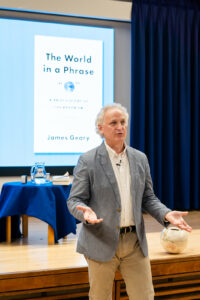
Thanks to everyone at the hallowed and historic Mechanics Hall in Portland, ME for hosting me and The World in A Phrase on Nov 18, to The Rabkin Foundation for helping make the evening possible, and to Back Cove Books for moving the merch. And thanks to the Portland peeps who came out to juggle words, ideas, and balls.

Every talk is different, because I put different aphorisms into the globe and because every time different aphorisms come out of the globe. There was no blank sheet selected from the globe at Mechanics Hall, but there was lots of conversation about and exchange of aphorisms — going on well after my talk officially ended. Just two of the memorable sayings shared and originated by members of the audience…

Good things happen when you get out of the house

excellent parental advice from an aphoristically-inclined dad, and

Hold the handlebars loosely

this latter aphorism by Mary Louise Schumacher, executive director of The Rabkin Foundation.

This one by author Ruha Benjamin is from a talk she gave at the Charleston Literary Festival:

Resistance is fertile.

And Bradley Shingleton, who was kind enough to attend my talk at Politics and Prose in DC and throw out the ceremonial first juggling ball, is teaching a continuing education class this winter on aphorisms. (Why didn’t I think of that?!) Bradley is also an aphorist, and here are a few of the sayings he shared with me…

Some knots should be loosened slowly rather than cut quickly.

Worrying about insomnia keeps me awake at night.

It takes at least two people to create loneliness.

In other aphorism-related news, NPR’s L. Carol Ritchie wrote an ode to the passing of the penny in which she lists some of the penny-centric sayings inspired by this humble coin — ‘in for a penny, in for a pound’, etc… She asked me why I thought the penny was so proverbial, such a rich image for aphorisms, which prompted these thoughts and an aphorism…

I think the penny lends itself to aphorisms because they are both small — the aphorism is the shortest form of literature, and the penny is the smallest monetary denomination. Though pennies and aphorisms are both small, they both contain a lot of value, which is where I think so many of the common expressions involving pennies come from … a penny for your thoughts, the penny dropped, a penny saved is a penny earned. An aphorism collection is in many ways like the jar of pennies so many of us collected as kids; keep adding to your collection long enough, and you’ll find yourself unexpectedly wealthy when you start counting the pennies and unexpectedly wise when you start recounting the aphorisms.

Put a penny on your prison floor. Now you live in a vault.

This aphorism is by JPJ, a mysterious aphorist about whom nothing is known apart from the fact that the author self-published a book in 2009 called Last Aphorisms. I like this aphorism because it suggests how we can transform negative situations by bringing some kind of value to them ourselves. If we find ourselves imprisoned in an unsatisfying circumstance, bring something worthwhile to it and that will transform both the circumstance and the way we regard the circumstance.

Finally, in still other aphorism-related news, Seán Moncrieff had me on his Newstalk radio show in Ireland to banter a bit about aphorisms…

The World in A Phrase at Politics and Prose

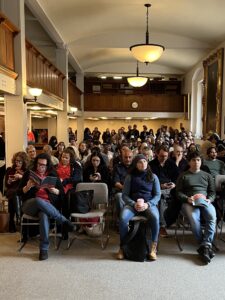
Thanks to the wonderful team at Politics and Prose for hosting me and The World in A Phrase on Nov 15. And thanks to everyone — shout out to the Nieman Fellows! —who came out to juggle words, ideas, and balls.
There was a blank sheet selected from the globe — in fact, it was the first sheet selected from the globe 😬 — and the subject was: Rhetoric. I came up with something from FDR …
Be sincere, be brief, be seated.

Welcome to The World in A Phrase!

Fortuna stands some seven feet tall, on a pedestal overlooking seven Black automatons, in the San Francisco Museum of Modern Art’s Roberts Family Gallery. The mechanized figures in plots of obsidian perform a kind of ritual resurrection: One automaton, limbs flailing, repeatedly rises from and falls to the ground, summoned by another robot dressed in the robes of a prophet.

Fortuna takes it all in, periodically raising her arm and pointing to her mouth as an aphorism printed on a slip of paper pops out:

Your last shred of dignity is often your best.

Life is the abyss into which we deliberately and joyfully thrust ourselves.

Artists cannot be expected to follow instructions.

This diorama of suffering and redemption is Fortuna and the Immortality Garden (Machine) by Kara Walker, an artist whose cut-paper silhouettes and installations have long engaged with complex issues of race, racism, and identity, as does this work. Fortuna the machine is also a contemporary variation on the crude mechanical fortune tellers once found in penny arcades. Drop a coin into the slot at the amusement park, and Zoltar or Madame Zita would produce a card with a prediction of your future on it. Fortuna herself may be a wonder of modern animatronics, but dispensing cryptic wisdom goes back to the beginnings of the aphorism and is one of the oldest ways we make sense of our world.

Aphorisms are the original oracles. Walker’s Fortuna connects today’s museumgoers with the people thousands of years ago who played the I Ching or consulted Pythia, the priestess of the Temple of Apollo at Delphi, for insights on the future and guidance on the here and now. The aphorism is, in some ways, perfectly suited to the digital age: The oldest form of literature finds its ideal vehicle in the most modern short modes of communication. Connecting current expressions of the aphorism with its ancient roots is one reason I’ve prepared a new edition of The World in A Phrase: A Brief History of the Aphorism, twenty years after it first appeared.

New aphorists are featured throughout this second edition of The World in a Phrase — from a Roman orator and an Austrian countess to a Harlem Renaissance poet and a Colombian philosopher — encompassing more voices and bringing this brief history up to date. Twenty-­six additional aphorists have been added to the original thirty-­eight, for a total of sixty-­four practitioners through which the history of the form is told.

When the book was first published in 2005, Facebook had only just been founded and Twitter didn’t exist. In the two decades since, the proliferation of social media —­ which places a premium on brevity, the aphorism’s essence —­ has created forums in which this shortest of short forms can thrive. Twitter, after all, has the word ‘wit’ in it. An entirely new chapter at the end of the book features those using new platforms to take the form into the future, including meme-makers, street artists, and visual aphorists who mix pithy language with compelling imagery.

Twitter, of course, also has the word ‘twit’ in it and, now known as X, it marks the spot where the unaphoristic reigns, from gauzy inspirational quotes to byte-­sized chunks of outrage. This new edition addresses the crucial differences between aphorisms and hot takes and rage posts, and it explores why, especially as generative AI programs like ChatGPT threaten to reduce our cognitive loads to zero, it is essential to our psychological survival to think aphoristically. Aphorisms remain the ultimate deep dives, even in our era of fractured attention spans, when TL;DR has become the catchphrase of a generation.

Kara Walker’s work is part of the millennia-­old tradition of the aphorism. Her aphorisms are proof of the enduring vitality of the form and its continuing popularity today. My hope is that this updated edition of The World in a Phrase will be timely and relevant for new readers as well as longtime aphorist aficionados.

The World in A Phrase arrives on my doorstep (literally)

Receiving the first copies of a book you have written is the oddest feeling… The object before you has lived in your mind for years, and you have spent many days working to place what is inside your mind outside your mind so others can see it.


UCP box


The book is like a black box at first. What’s inside it? Did I write it? It seems like so long ago. And it was so long ago! Because the wheels of publishing turn slowly. But the grind — the writing, the promoting, the waiting — feels exceedingly fine (eventually).


Then it’s like meeting an old friend you haven’t seen in a long time. At first, you’re not quite sure it’s him — he’s changed a bit and so have you. But then you look again and yes, it’s him! I remember now. I wrote this. How wonderful to see you again!


Please come in. Make yourself at home. Stay awhile.


Have you met my daughter, Hendrikje? I think this is the beginning of a beautiful friendship.