You only fail if you quit

I love it when life delivers literature.

New neighbors are moving in across the street, and they have entrusted the Anthony Ward Thomas firm with all their worldly goods. Two bright red Anthony Ward Thomas moving trucks were parked across the street all day yesterday. In Greek, the word for ‘transport’ is metaphorá (μεταφορά), so all the moving trucks in Greece have metaphorá written across their sides. This is where the English word ‘metaphor’ comes from, which metaphorically means to transport the meaning of one thing to another thing.

So yesterday the Anthony Ward Thomas firm literally delivered two aphorisms to my front door:

You only fail if you quit

and

Action is the real measure of intelligence

This is what aphorisms do: Deliver practical wisdom for everyday life right to your front door.

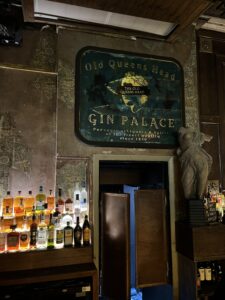
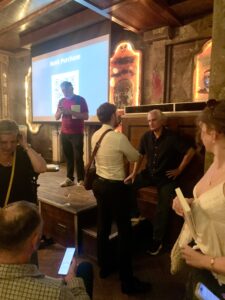
The World in A Phrase at The Old Queen’s Head pub in Islington

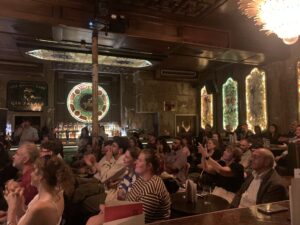
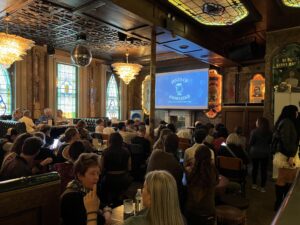
Thanks to Callum, Ben and Oliver at the amazing Pints of Knowledge for hosting me and The World in A Phrase on August 24. And thanks to all the engaged and enthusiastic folks who came out to the magnificent Old Queen’s Head “gin palace” in Islington to juggle words, ideas, and balls.

What a lovely, atmospheric space it is upstairs at the Old Queen’s Head! And what a perfect venue for an hour-long conversation about aphorisms, practical philosophy for daily life.

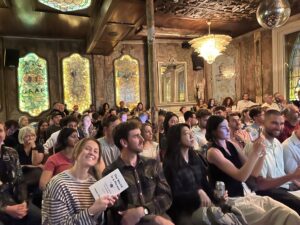
There was a blank sheet selected from the globe and the theme was: loss. The audience had some helpful suggestions — along classic Stoic lines like ‘Never love anything that can be taken away’ and romantic lines like ‘It is better to have loved and lost than never to have loved at all’ by Alfred, Lord Tennyson — as I racked my brain to remember a haunting aphorism by Antonio Porchia. Alas, I could only recall the second part of the aphorism, so the person who chose the blank sheet got a free copy of my book. You can see her in this pic at bottom left:

And the aphorism by Porchia, who in the mid-20th century ran a small printing business with his brothers in Argentina before retiring to his garden to write aphorisms, is

The loss of a thing affects us until we have lost it altogether.

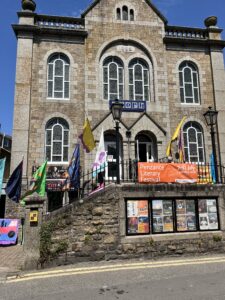
The World in A Phrase at the Penzance LitFest

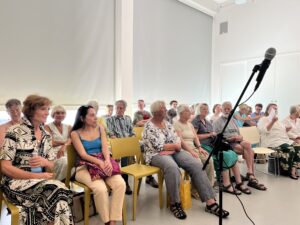
Many thanks to everyone who came out on July 10 in the sweltering heat at the Penzance LitFest to talk about aphorisms and language with me and Will Jelbert. “If you can’t stand the heat, get out of the kitchen,” a saying often attributed to Harry S. Truman, came to mind as a single tiny fan valiantly tried to circulate fresh air around the room. I’m grateful that everyone withstood the temperature to cook up a great discussion…

Aphorisms by Dražen Jergović

Dražen Jergović is an electrical engineer by profession and an aphorist by vocation. He is the author of three books of humor/satire — Rideamus, The Key to (Un)Success and The Diary of a Niggler — and leads workshops on writing short humorous/satirical pieces for both children and adults. Based in Zagreb, Croatia, he is vice-president of the Association of Croatian Aphorists and Humorists (UHAH) and the Association of Artists August Šenoa as well as the founding editor-in-chief of the online magazine Uh!Aha. A selection of Dražen’s aphorisms…

The unemployed get a break all day, the employed only get half an hour.

A book is practically the only object you can leave anywhere without fear of someone stealing it.

Where the blood is hot, the head must be cool.

Where there is much to do, few are interested.

Filling our pockets, we empty our hearts.

The past is before us.


The World in A Phrase at the Cambridge Literary Festival

Many thanks to everyone at the Cambridge Literary Festival for hosting me and The World in A Phrase on April 25. And thanks to everyone who came out to juggle words, ideas, and balls. There was a blank sheet selected from the globe, and the topic was “agriculture.” I offered philosopher and statesman Francis Bacon’s aphorism:

Nature, to be commanded, must be obeyed.

Though Bacon coined this phrase in medieval times, it goes some way to explaining our current climate crisis. We have for generations been disobeying fundamental laws of nature, and as a result we now can’t command or control the extreme weather to which we’re subject.

The person who picked the blank sheet from the globe, the son of a farmer, offered an aphorism from his father:

The best manure is the farmer’s boots.

A lovely evocation of the need to get your hands — and your boots — dirty if you want to make something grow.

You can check out my talk on the Festival’s CLF Player.

The World in A Phrase at the International Festival of Literature Dublin

Many thanks to everyone at the wonderful International Festival of Literature Dublin for inviting me to talk about aphorisms, and many thanks to everyone who came out on a cold, rainy Dublin Sunday afternoon for my conversation with John Connell, author of The Wisdom of Farmers: What We Can Learn from the Land, moderated by writer/editor Gary Quinn.


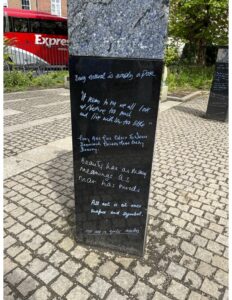
Aphorisms are everywhere in Dublin, including in Merrion Square Park, where the Festival is held. The park features a sculpture of Oscar Wilde reclining on a rock. Nearby is a little obelisk with some of Wilde’s sayings on it…

To become a work of art is the object of living.

Only the shallow know themselves.

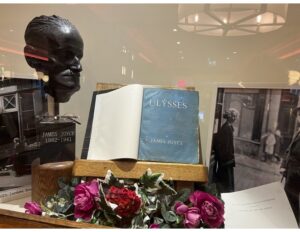
Of course, James Joyce is everywhere in Dublin, too. My first stop was Davy Byrnes, the “moral pub” Leopold Bloom visits in Ulysses, which I discovered has a ravishing first edition of the novel in the back behind glass.

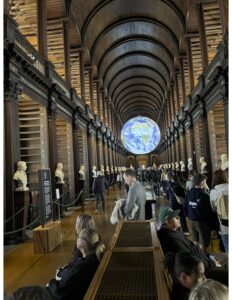
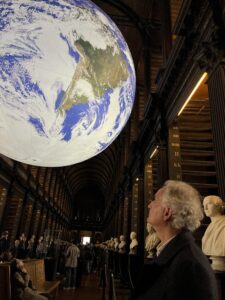
And no visit to Dublin is complete without paying homage to the spectacular Book of Kells housed in the Old Library at Trinity College. The Long Room of the Old Library also holds Gaia by Luke Jarrams, which hovers majestically above the dark shelves and the august white busts of Irish scholars.

Joyce put the world into a book, Ulysses, and Trinity College put the world in a library.

Aphorisms by Piotr Bardzik

Piotr Bardzik describes himself as Polish by birth, Maltese by love, European by conviction, and bean counter by profession. He neglects to mention one important biographical detail: aphorist by avocation. Bardzik has channeled what began as regular journal entries into two books of aphorisms, Fact Denounced as a Four-letter Word and Washington Post is Switching Off Lights, which he calls “accidental thoughts in a world dominated by common nonsense.” A selection …

Opinions, and not religion, are the opium of the people.

Privilege — a one-sided coin.

Being open-minded requires a lot of effort. Being narrow-minded is effortless.

At birth, we all get a life sentence.

The surest way to a permanent outcome? Resort to a temporary measure.

Tautology? It is what it is

Aphorisms by Andrzej Majewski

“Nothing makes life more complicated than taking the easy way out,” Andrzej Majewski writes in Wisdom for Every Occasion. But in his collection of aphorisms, Majewski, organizer of last year’s International Aphorism Conference in Wroclaw, Poland, provides no easy answers, just plenty of complicated aphorisms for complicated times. Working within the grand tradition of the 17th- to 19th-century French moralists, with a distinctively Central European sardonic twist, Majewski’s aphorisms offer wry, apt, refreshingly uneasy takes on politics, society and everything in between. A selection …

An aphorist—a person with little to say.

Children need love most when they deserve it least.

The poor always fight the wars of the rich.

Remember: when you bow your head you make it easier for the executioner.

Never hire the best lawyer; the worst judge will be cheaper.

Freedom is like a windowpane—almost invisible until someone shatters it.

Greguerías by Darko Batan Žunjić

Karl Kraus called his aphorisms “prejudices,” “illusions,” or “splinters”; Antonio Porchia, “voices”; Stanisław Jerzy Lec, “trifles”. Colombian aphorist Nicolás Gómez Dávila designated his sayings escolios, or “glosses,” after the ancient practice of penning notes and commentaries in the margins of other books, and Ramón Gómez de la Serna came up with greguerías.

Gómez de la Serna defined greguerías as “merely fatal exclamations of things and of the soul, upon bumping into one another by pure chance.” These meetings introduce two unlikely things to each other, whose interplay then produces weird and wonderful imagery:

Tombs should be made with periscopes.

Gómez de la Serna even devised the formula by which these peculiar sayings were created: humor + metaphor = greguería. Though the images are exotic, the metaphors are relentlessly pedestrian and the comedy is brilliantly observational, revealing little existential dilemmas in seemingly commonplace encounters:

After helping a blind man across the road, we remain slightly undecided

or teasing out psychological insights from unguarded moments:

What most reveals a man’s character is the face he makes when his match goes out on him.

Montenegran aphorist, poet, and anthologist Darko Batan Žunjić has taken up the form in a way that honors Gómez de la Serna’s oddball observations and whimsical juxtapositions. Žunjić is the author of three poetry collections (Nit, Čarolija nedostatka, and Lepršave latice, the latter a collection of haiku) and two collections of aphorisms (Sve po zakonu and Ringišpil maski). A selection of his greguerías

A shutter is the eyelid with which one building winks at another.

A book is a warehouse of tiny letters.

A saxophone is a pipe that sings.

Sand is the skin of the beach.

A shadow is the hand of a sundial.

Epigrams by Jim Adams

What is the difference between an aphorism and an epigram? Epigrams usually rhyme, are often funny and cynical, and are often intended to castigate or criticize a rival. When they are also philosophical, they are aphorisms. Martial (Geary’s Guide, pp. 293-294) is the Western author most closely associated with the form, though people like Dorothy Parker, Ogden Nash, and Alexander Pope also wrote what could be considered epigrams. Jim Adams writes epigrams that meet the aphoristic criterion. His use of the form, he writes, reflects his “‘essentialist’ disposition, one that pushes me to do my best to get to the core of things, and to respond to what I find as simply and concisely as possible.” His website has more about his epigrams and paintings, which he calls “visual epigrams,” as well as his book, Epigrams.


Different Strokes


Some

Curse

The

Distractions

That

Keep

Them

From

Living their lives,

Others

Can’t

Live

Without

Them.


Tautologies


Taking

The

Lord’s

Name

Is

Always

In

Vain.


Generation


No

Single

Little

Thing

Changes

Things

More than

An

Offspring.


Parallels


Somehow,

Both love

And

Democracy

Are

Particularly

Vulnerable

To the

Contempt

Of

Familiarity.


GDP


A

Truly

Developed

Country

Would

Know

It

Need

No

Longer

Grow.


Recipe


Tolerance’s

Main

Ingredient

Is

Expedience.