The World in A Phrase at the International Festival of Literature Dublin

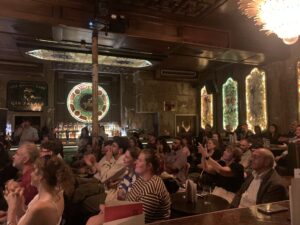
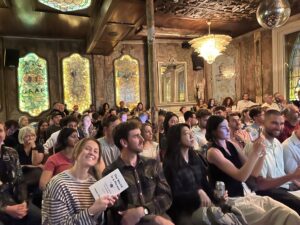
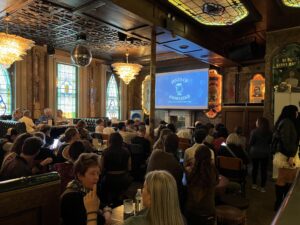
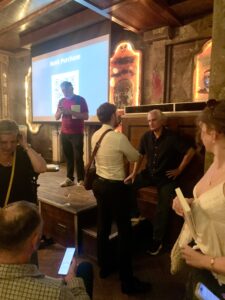
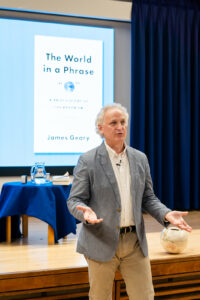
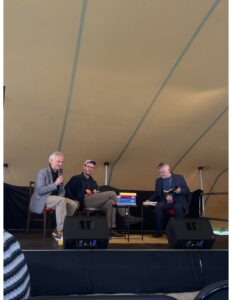
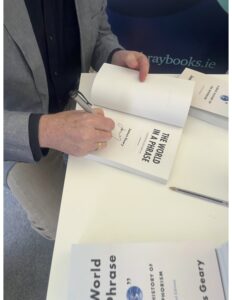
Many thanks to everyone at the wonderful International Festival of Literature Dublin for inviting me to talk about aphorisms, and many thanks to everyone who came out on a cold, rainy Dublin Sunday afternoon for my conversation with John Connell, author of The Wisdom of Farmers: What We Can Learn from the Land, moderated by writer/editor Gary Quinn.


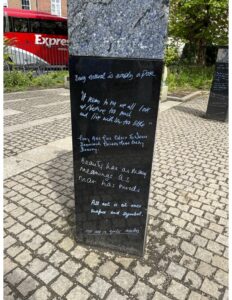
Aphorisms are everywhere in Dublin, including in Merrion Square Park, where the Festival is held. The park features a sculpture of Oscar Wilde reclining on a rock. Nearby is a little obelisk with some of Wilde’s sayings on it…

To become a work of art is the object of living.

Only the shallow know themselves.

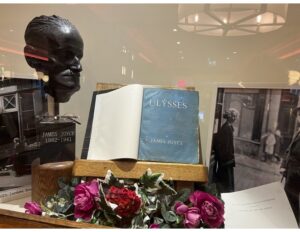
Of course, James Joyce is everywhere in Dublin, too. My first stop was Davy Byrnes, the “moral pub” Leopold Bloom visits in Ulysses, which I discovered has a ravishing first edition of the novel in the back behind glass.

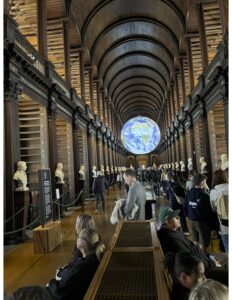
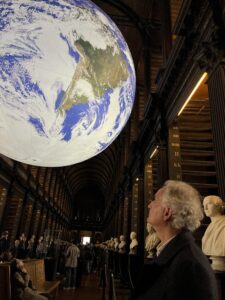
And no visit to Dublin is complete without paying homage to the spectacular Book of Kells housed in the Old Library at Trinity College. The Long Room of the Old Library also holds Gaia by Luke Jarrams, which hovers majestically above the dark shelves and the august white busts of Irish scholars.

Joyce put the world into a book, Ulysses, and Trinity College put the world in a library.

Aphorisms by Piotr Bardzik

Piotr Bardzik describes himself as Polish by birth, Maltese by love, European by conviction, and bean counter by profession. He neglects to mention one important biographical detail: aphorist by avocation. Bardzik has channeled what began as regular journal entries into two books of aphorisms, Fact Denounced as a Four-letter Word and Washington Post is Switching Off Lights, which he calls “accidental thoughts in a world dominated by common nonsense.” A selection …

Opinions, and not religion, are the opium of the people.

Privilege — a one-sided coin.

Being open-minded requires a lot of effort. Being narrow-minded is effortless.

At birth, we all get a life sentence.

The surest way to a permanent outcome? Resort to a temporary measure.

Tautology? It is what it is

Aphorisms by Andrzej Majewski

“Nothing makes life more complicated than taking the easy way out,” Andrzej Majewski writes in Wisdom for Every Occasion. But in his collection of aphorisms, Majewski, organizer of last year’s International Aphorism Conference in Wroclaw, Poland, provides no easy answers, just plenty of complicated aphorisms for complicated times. Working within the grand tradition of the 17th- to 19th-century French moralists, with a distinctively Central European sardonic twist, Majewski’s aphorisms offer wry, apt, refreshingly uneasy takes on politics, society and everything in between. A selection …

An aphorist—a person with little to say.

Children need love most when they deserve it least.

The poor always fight the wars of the rich.

Remember: when you bow your head you make it easier for the executioner.

Never hire the best lawyer; the worst judge will be cheaper.

Freedom is like a windowpane—almost invisible until someone shatters it.

Greguerías by Darko Batan Žunjić

Karl Kraus called his aphorisms “prejudices,” “illusions,” or “splinters”; Antonio Porchia, “voices”; Stanisław Jerzy Lec, “trifles”. Colombian aphorist Nicolás Gómez Dávila designated his sayings escolios, or “glosses,” after the ancient practice of penning notes and commentaries in the margins of other books, and Ramón Gómez de la Serna came up with greguerías.

Gómez de la Serna defined greguerías as “merely fatal exclamations of things and of the soul, upon bumping into one another by pure chance.” These meetings introduce two unlikely things to each other, whose interplay then produces weird and wonderful imagery:

Tombs should be made with periscopes.

Gómez de la Serna even devised the formula by which these peculiar sayings were created: humor + metaphor = greguería. Though the images are exotic, the metaphors are relentlessly pedestrian and the comedy is brilliantly observational, revealing little existential dilemmas in seemingly commonplace encounters:

After helping a blind man across the road, we remain slightly undecided

or teasing out psychological insights from unguarded moments:

What most reveals a man’s character is the face he makes when his match goes out on him.

Montenegran aphorist, poet, and anthologist Darko Batan Žunjić has taken up the form in a way that honors Gómez de la Serna’s oddball observations and whimsical juxtapositions. Žunjić is the author of three poetry collections (Nit, Čarolija nedostatka, and Lepršave latice, the latter a collection of haiku) and two collections of aphorisms (Sve po zakonu and Ringišpil maski). A selection of his greguerías

A shutter is the eyelid with which one building winks at another.

A book is a warehouse of tiny letters.

A saxophone is a pipe that sings.

Sand is the skin of the beach.

A shadow is the hand of a sundial.

Epigrams by Jim Adams

What is the difference between an aphorism and an epigram? Epigrams usually rhyme, are often funny and cynical, and are often intended to castigate or criticize a rival. When they are also philosophical, they are aphorisms. Martial (Geary’s Guide, pp. 293-294) is the Western author most closely associated with the form, though people like Dorothy Parker, Ogden Nash, and Alexander Pope also wrote what could be considered epigrams. Jim Adams writes epigrams that meet the aphoristic criterion. His use of the form, he writes, reflects his “‘essentialist’ disposition, one that pushes me to do my best to get to the core of things, and to respond to what I find as simply and concisely as possible.” His website has more about his epigrams and paintings, which he calls “visual epigrams,” as well as his book, Epigrams.


Different Strokes


Some

Curse

The

Distractions

That

Keep

Them

From

Living their lives,

Others

Can’t

Live

Without

Them.


Tautologies


Taking

The

Lord’s

Name

Is

Always

In

Vain.


Generation


No

Single

Little

Thing

Changes

Things

More than

An

Offspring.


Parallels


Somehow,

Both love

And

Democracy

Are

Particularly

Vulnerable

To the

Contempt

Of

Familiarity.


GDP


A

Truly

Developed

Country

Would

Know

It

Need

No

Longer

Grow.


Recipe


Tolerance’s

Main

Ingredient

Is

Expedience.


Aphorisms by Richard Greene

Richard Greene started writing aphorisms after noticing that a line in one of his poems read like an aphorism — a self-contained gnomic utterance. (For a consideration of poems as aphorisms, see my discussion with Neil Denny of Emily Dickinson, Dorothy Parker, and Samuel Hoffenstein on the Little Atoms (24:15-26-35) podcast.) “Aphorisms appealed to me because, like poetry, slogans and rhetoric, [they have] an emotional resonance that other prose has more rarely or in an attenuated form … Aphorisms frequently exaggerate, stating as universal truths that are only conditional … That doesn’t detract from their wisdom. Hyperbole contributes to their rhetorical impact.” Richard self-published his aphorisms as A Curmudgeon’s Guide to Post-Modern Times: Aphorisms. Herewith a selection of Richard Greene’s curmudgeonly guidance…

The truly strong are those who aren’t driven by the need to prove their strength.

Mankind is an endangering species.

The main challenge to human welfare is human nature.

I don’t need to be reborn. I got it right the first time.

Sooner or later the cutting edge becomes dull.

Poetry is the art of the implied.

In poetry it’s the difference between synonyms that counts.

The World in a Phrase at the Charleston Literary Festival

The video of my appearance at the Charleston (SC) Literary Festival back in November was recently posted, which gives me an opportunity to once again thank Diana Reich, Sarah Moriarty, and the whole Charleston Literary Festival team, especially the crew at the splendid Dock Street Theatre who got the lights just right for juggling (even though I dropped the ball) and Ladybird Books for selling the books. And thanks to splendid audience who turned out to juggle words, ideas, and balls.

There was a blank sheet selected from the globe, and the subject was: Soccer, which allowed me to share once again the timeless wisdom of Johan Cruijff, a Dutch soccer star whose distinctive sayings have been given their own name: Cruijffisms.

Without the ball, you can’t win.

Before I make a mistake, I do not make that mistake.

Every disadvantage gots its advantage.

Cruijff is like a Dutch Yogi Berra, an inadvertent aphorist whose philosophical non sequiturs are spontaneous rather than deliberate. And the choice of Soccer as a subject gave me the chance to share some of my favorite Yogi anecdote: Once in an Italian restaurant, Berra was asked if he wanted his pizza cut into four or eight slices. “Four,” he said. “I don’t think I can eat eight.”

Aphorisms by Charles R. Castle

After retiring from a career in healthcare and becoming “a rather late in life poet,” Charles R. Castle developed a fascination with aphorisms during the pandemic, a fascination fueled by W.S. Merwin’s translations in Asian Figures and his Voices of Antonio Porchia (see The World in a Phrase, pp 217-220). Charles included about 100 of his aphorisms as the final chapter of his poetry collection, On the Beach of Borrowed Time. “I’ve found my aphorisms to be an effective change of pace to add to a poetry reading,” Charles says. “The shorter book has also been a way for me to make a political response to current events. I sell or give them away at marches and street protests. We are living in historically interesting times. If nothing else, my great grandchildren will know I made some small effort to express my opposition to the insanity we are witnessing and perhaps I will encourage them to do the same in the future. Why else do we write?” Here is a selection of Charles’s “Aphorisms for an Absurd World”…

You can’t write the book of your life standing in the margins

The straw that broke the camel’s back was carried on the wind

The most precious gifts are rarely wrapped

Old ideas may kill us with new weapons

Judge us by how we treat the weak

not by how we arm the strong

What doesn’t kill you just needs more time

An eye for an eye and a tooth for a tooth

costs and arm and a leg

Less road rage on the road less traveled


This week in The World in a Phrase V

Thanks to Neil Denny for such a fun, wide-ranging conversation on the Little Atoms podcast, largely structured around consideration of individual aphorists from the book, including Jesus (12:00-14:50), Jean Toomer (20:00-22:05), Emily Dickinson, Dorothy Parker and Samuel Hoffenstein (24:15-26-35), and Sarah Manguso (28:30-30:30), among others.

And thanks to Jacke Wilson at The History of Literature podcast for an equally fun, wide-ranging conversation featuring a discussion of aphorisms as mnemonic devices for intense experience (14:30-16:00) and aphorisms as rhetorical devices (28:10-32:50) and also, coincidentally, largely structured around consideration of individual aphorists from the book, including Confucius (34:30-36:50), Montaigne (37:00-39-25), and E.M. Cioran (39:40-43:45).

For an excellent exploration of aphorisms as expressions of political dissent and social critique, check out The Londoner’s profile of Nick, who hangs billboards with aphorisms and aphorism-adjacent slogans on them from the balcony of his second-floor flat near Finsbury Park station. Each of Nick’s signs, Roland Hughes reports, “always have a phrase painted on it, [are] always nearly a metre high, always in bold, black-on-white sans-serif lettering. When it comes to his messages, Nick has a few rules. They will contain a pithy, usually three- or four-word slogan. They will usually hint at a deep distrust of authority and, to put it politely, the way information is distributed. There will be common themes: war, protest laws, surveillance, the media. Nick’s favourites, he says, are ‘ones that question the narratives; the acceptance of which, let’s face it, has got us into a terrible state.’”

Some of Nick’s posts include…

WHICH LIES DO YOU BELIEVE?

EXPECT ANOTHER FALSE FLAG PSYOP

MAKE THE SKY BLUE AGAIN

REGISTER YOUR CHICKEN

Nick’s work is a great example of the aphorism as public art, appropriating the language and distribution methods of advertising to make political statements, as artists like Jenny Holzer and Barbara Kruger have been doing since the 1970s.

Aphorisms by Vincent Straub

One of the things that’s most fun about doing book talks is hearing all the aphorisms people share with me before, during, and after the talks. After a recent talk, Vincent Straub, a university student, handed me an envelope that contained a selection of his aphorisms, which are sharp, funny, and have the philosophical twist we spent some time discussing during the talk. Here are a few of his sayings…

Those who do not want to live together will die together.

In today’s world, nothing is as present as absence.

Our best political friendships are with those with whom we share the same level of confusion.

Heaven is a dance floor with bookshelves.

In an email exchange with Vincent, I suggested he might want to revise some of his aphorisms after writing them. As someone who typically practices the ‘spontaneous combustion’ method of aphorism composition, I need to hear this advice myself. It might seem strange to revise a composition that’s already so short, maybe a dozen words at most. But revision is part of the writing process for works of every length; it’s not an optional afterthought or something you do when you’re ‘finished.’ For example, the ironic effect of Vincent’s

It is a marvel to grow up and watch how your parents develop

could be heightened by changing up the word choice:

It is a marvel to grow up and watch your parents mature.

The word ‘mature’ has richer connotations in this context and enhances the reversal of a child watching parents mature when usually it’s the other way around. Similarly, further refining already refined sentences like

Those who stay sitting will never feel their shackles

can make them even more pointed and powerful:

You never feel your shackles if you never stand up.

Distilling ‘stay sitting’ into ‘stand up’ adds crucial allusions to ‘standing up for yourself’ while the addition of the second person form of direct address makes the whole more definitive.

I had the chance to see the rewards of revision in my own work after rediscovering some aphorisms I had written while living in San Francisco. I noted that an early version of one saying read

I’d rather be a voice in the desert than a face in the crowd

but I revised it to

Better a voice in the desert than a face in the crowd

which is much stronger since it removes the first person reference, making the observation more outward-directed, and it changed the sentence from a preference to a directive, which prompted the composition of an aphorism about writing, which spontaneously combusted and I did not revise:

Revision is precision.