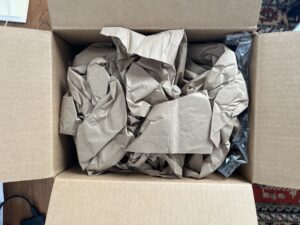
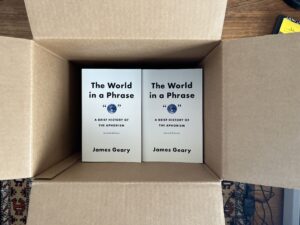
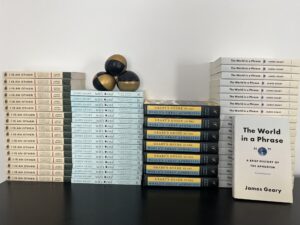
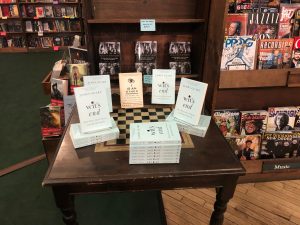
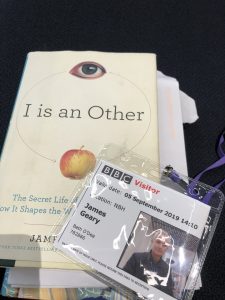
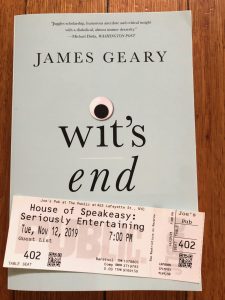
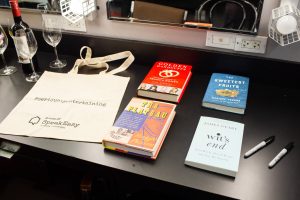
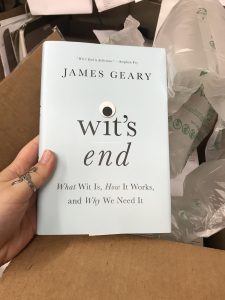
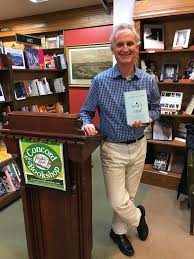
Receiving the first copies of a book you have written is the oddest feeling… The object before you has lived in your mind for years, and you have spent many days working to place what is inside your mind outside your mind so others can see it.
The book is like a black box at first. What’s inside it? Did I write it? It seems like so long ago. And it was so long ago! Because the wheels of publishing turn slowly. But the grind — the writing, the promoting, the waiting — feels exceedingly fine (eventually).
Then it’s like meeting an old friend you haven’t seen in a long time. At first, you’re not quite sure it’s him — he’s changed a bit and so have you. But then you look again and yes, it’s him! I remember now. I wrote this. How wonderful to see you again!
Please come in. Make yourself at home. Stay awhile.
Have you met my daughter, Hendrikje? I think this is the beginning of a beautiful friendship.
Through a series of fortunate hyperlinks, I recently stumbled across aphorisms on journalism by John Bennet, former New Yorker editor and professor in magazine writing at Columbia Journalism School. In a brief 2022 obit on the Columbia j-school site, Betsy Morais, editor in chief of the Columbia Journalism Review, wrote that Bennet “often spoke in aphorisms.” Those aphorisms are funny, wise, and profane — just like the best newsrooms.
Put the best shit at the end, the second-best shit at the beginning, and all the other shit in between.
The best journalists always overreport.
Don’t rob the reader of feeling emotions by reacting for them (“I started to cry”).
A writer is a guy in the hospital wearing one of those gowns that’s open in the back. An editor is walking behind, making sure that nobody can see his ass.
Richard Kostelanetz’s aphorisms of “radical constraint”
Richard Kostelanetz is interested in “radical constraint.” And the aphorism is the ideal form in which to put that interest into practice. Aphorisms are, by definition, short. But Kostelanetz takes concision to an extreme by restricting himself even further — to aphorisms consisting of just four (“quadrigraphs”), three, and two (“minimaxims”) words. Kierkegaard wrote, “The more restricted I am, the more creative I become.” That is certainly true of Richard Kostelanetz’s radically constrained aphorisms.
Four-word aphorisms
If uninvited, arrive late.
Anyone understood becomes predictable.
Three-word aphorisms
Eschew questionable explanations.
Pomposity precedes comeuppance.
Historians repeat themselves.
Leftovers attract vultures.
Publishing amplifies whatever.
Be seriously funny.
Write briefest classics.
Two-word aphorisms
desire desires
never generalize
sentences end
Scroll down on this page to read some of Richard Kostelanetz’s other four-word aphorisms.
I first blogged about the aphorisms of Ninus Nestorović back in December of 2007. Ninus was recently in touch with some new aphorisms, deftly translated by his 15-year-old daughter, Tea. Ninus is a journalist, satirist, and ex-professional footballer who lives in Novi Sad, Serbia. These sayings come from his book 11:52. In an email accompanying the aphorisms, Ninus wrote he believed I would like them — and I do!
To hide from the truth, a person need not stand behind the television, but in front of it.
The poor will leave their children everything they don’t have.
With clean hands you preserve health; with dirty hands, authority.
My city has more churches than hospitals. Were there a God, the numbers would be reversed.
Were the eyes nearer the heart than the mind we’d see differently.
Translated from Serbian into English by Tea Nestorović.
Ashleigh Brilliant, the prolific creator of the drawings-aphorisms he called “Pot-Shots”, died last month in in Santa Barbara, CA. This New York Times obit has a nice summary of his writing career and a selection of some of his best sayings. A piece in the local Santa Barbara outlet Noozhawk has more detailed information on his life. Brilliant started out as a painter rather than an aphorist. His paintings, however, never went over as well as the sharp, slightly loony titles he appended to them. So instead of working on canvas, he made quick pen-and-ink drawings to illustrate his aphoristic captions. “Soon, I was making lists of titles for pictures I had not yet painted,” Brilliant once said. His have been widely published since 1975, appearing on everything from coffee mugs to postcards. Brilliant’s rules for “Pot-Shots” composition were strict: no saying can have more than 17 words (17 is also the number of syllables in a haiku), none can rhyme, no references to politics, and every saying should be easily translated into other languages. He stopped writing “Pot-Shots” when he hit 10,000. Brilliant insisted that his work could only be reproduced with his permission, so I made certain to reach out to him back in 2007 when I included some of his “Pot-Shots” in Geary’s Guide. A very cordial exchange followed, in which Brilliant granted permission for me to include his work in my book. His only question, which he posed with an exclamation mark: Which of his “Pot-Shots” had I chosen?! Here they are, Brilliant’s sayings from a brilliant mind…
Life is the only game in which the object of the game is to learn the rules.
No man is an island but some of us are long peninsulas.
I feel much better, now that I’ve given up hope.
If we all work together, we can totally disrupt the system.
If you’re careful enough, nothing bad or good will ever happen to you.
I could do great things, if I weren’t so busy doing little things.
In order to discover who you are, first learn who everybody else is, and you’re what’s left.
If you can’t learn to do it well, learn to enjoy doing it badly.
Writer, teacher and translator Irving Weiss passed away on June 13. We have Irving to thank for bringing the aphorisms of Malcolm de Chazal into English.
Malcolm de Chazal (Geary’s Guide, pp. 359–361) was an aphorist and painter from Mauritius. I discovered the 1979 Sun edition of Chazal’s aphorisms, Sens-Plastique, by chance in a used bookstore in San Francisco in the mid-1980s. The cover has one of Chazal’s paintings on it — a pair of old shoes. Something spoke to me from the book, as sometimes happens when you encounter a book by someone you’ve never heard of in a used bookstore. I bought it and have been delighted and fascinated by Chazal ever since.
There are only three editions of Sens-Plastique in English, all of them the work of Irving. The latest and most comprehensive is from Green Integer, which also contains the introduction by W.H. Auden, a Chazal aficionado, which Irving arranged for the original 1971 publication of selections from Sens-Plastique.
Irving knew Auden from his college days in Michigan in the 1940s. He and his wife, Anne, lived on the Italian island of Ischia when Auden did. (They are featured in the BBC documentary about Auden, “Tell Me The Truth About Love”; Auden blessed their marriage by dedicating his and Chester Kallman’s translation of Die Zauberflöte to them.)
Irving found Sens-Plastique in the original French on Auden’s bookshelves. “Opening it at random, I was almost immediately struck by what I read, the lightning bolt transforming into, ‘This is what I wd write if I could, so I must translate it,’” Irving wrote to me in an email in 2008.
Irving translated a few pages and found Chazal’s address through Gallimard, his French publisher, and Chazal was delighted with Irving’s work. “We corresponded in French until one day years later he switched to perfect English,” Irving wrote to me, “and I remembered that he had attended Louisiana State University for six years studying agronomy.”
Irving corresponded with Chazal from the 1950s through the 1970s, though the two never met in person. He also published translations from Chazal’s Poèmes and Sens Magique, which are also aphoristic:
A rock needs no burial till it dies.
Eggs are all chin.
Irving told me that Chazal actually considered his Sens-Plastique observations science, not metaphor. That makes sense, given the uncanny precision of the aphorisms…
Light shining on water droplets spaced out along a bamboo stalk turns the whole structure into a flute.
Irving and I connected thanks to artist, author and critic Richard Kostelanetz, who mentioned my books to Irving. Irving did a search online, found this excerpt from a 2008 aphorism talk in which I discuss Chazal and read some of his aphorisms (and get the year of his death wrong; Chazal died in 1981), and then emailed me.
We had a lively email exchange — in extremely large type because of Irving’s failing eyesight! — and I was delighted to learn more about Irving’s relationship with Chazal and Auden and about Irving’s own works, including Reflections on Childhood, an anthology compiled and written with Anne, his wife. (I wrote about Reflections on Childhoodhere.)
Irving was funny, generous with his insights, and endlessly curious about aphoristics. I am fortunate to have known him, even if only electronically, and am forever grateful to him for introducing me to Chazal, one of the strangest and most original aphorists of all time…
Death is the bowel movement of the soul evacuating the body by intense pressure on the spiritual anus.
The sun is pure communism everywhere except in cities, where it’s private property.
The act of love is a toboggan in which those who are joined become each other’s vehicle.
Objects are the clasps on the pockets of space.
Age adds a pane of glass each year to the lantern of the eye.
Irving signed off all his emails with the phrase, “All to the Good.”
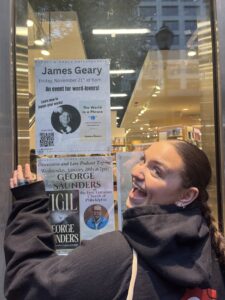
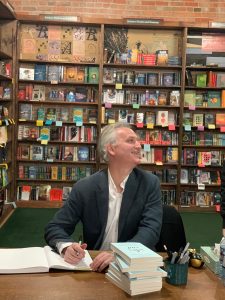
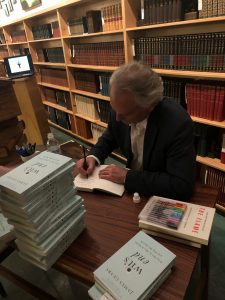
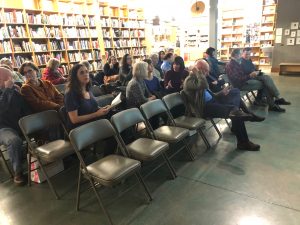
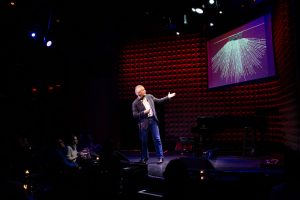
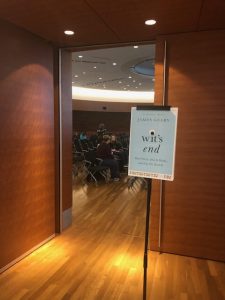
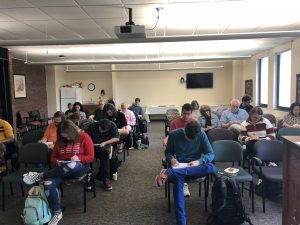
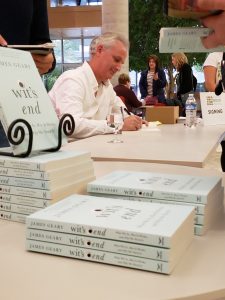
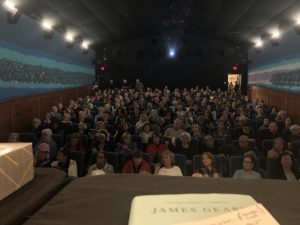
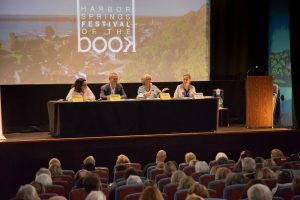
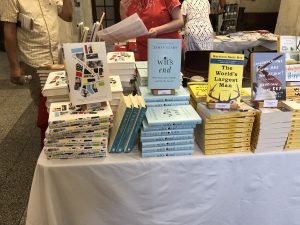
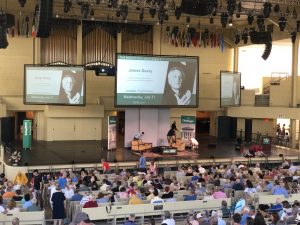
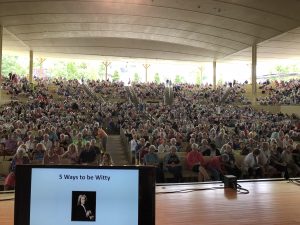
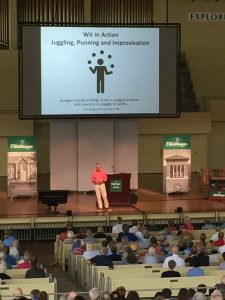
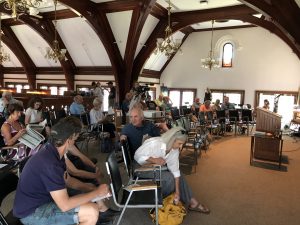
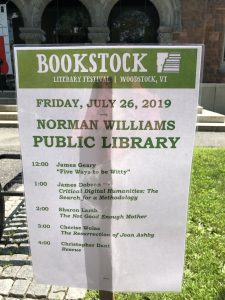
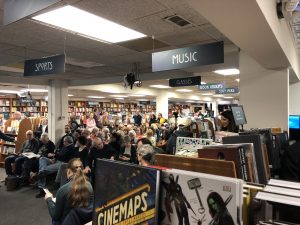
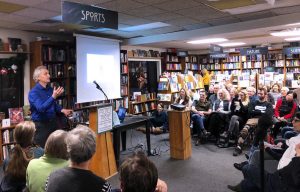
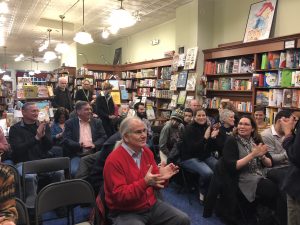
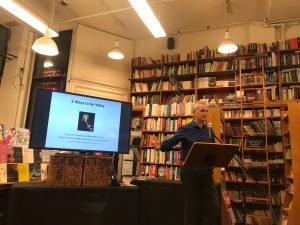
The Wit’s End World* Tour is winding down, but here’s a little visual retrospective of the places I’ve been and the people I’ve met. My thanks to all the booksellers, bookshops, festivals, and organizers of these events—and especially to everyone who turned out to talk about wit.
(* By ‘World’, of course I mean the United States of America…)
I’ll be adding new dates to the Events section of my homepage as they are booked. In the meantime, I’ll be taking a turn on stage here…
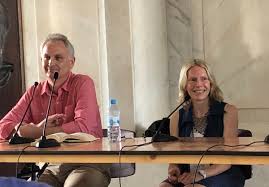
Groucho Marx makes a surprise appearance at the Harbor Springs Festival of the BookFrom left: Cathleen Schine, me, Mary Norris, and moderator Dianna Behl
But Wit’s End live is a lot of fun, too. If you want to discover how wit can entertain and enlighten even in the darkest times, come on by one of the appearances listed below.
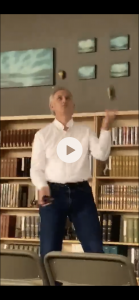
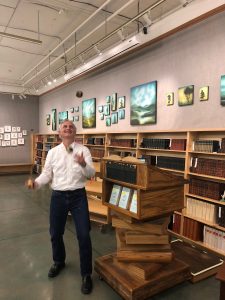
I’ll explore key aspects of wit through film clips, folktales, literary anecdotes, jokes, and juggling—of ideas, words and balls. There will be word games, short creativity tests, and a pun competition, the winner of which receives a free copy of the book!
For a teaser of the event (and the book), check out this short video.
Thank you!
Authors on Stage
Wellesley College Club
727 Washington Street, Wellesley, MA
November 07, Wednesday – 10:00 – 11:30 AM
Concord Bookshop
65 Main St, Concord, MA
November 8, Thursday – 7:00 – 8:30 PM
Northshire Bookstore
4869 Main St, Manchester, VT
November 10, Saturday – 6:00 – 7:30 PM
Harvard Book Store
1256 Massachusetts Ave, Cambridge, MA
November 14, Wednesday – 7:00 – 8:30 PM
Head House Books
619 South 2nd St, Philadelphia, PA
November 16, Friday – 7:30 PM
Spoonbill & Sugartown
99 Montrose Ave, Brooklyn, NY
November 18, Sunday – 7:00 – 9:00 PM
The Half King
505 W 23rd St, New York, NY
November 19, Monday – 7:00 – 8:30 PM
Attending a reading by Terrance Hayes at the Harvard Book Store the other day, I happened to sit next to Simon Constam. We happened to get to talking, and we happened to discover that we both write and read aphorisms. As Simon said, “the odds are astronomical against two people interested in aphorisms just happening to sit down beside each other.” So here, against the odds, is a selection of some of the aphorisms Simon subsequently shared with me, drawn from his manuscript-in-progress…
Exile is, like everything else, too much of a good thing.
Night after night all the things that do not change / Are startled by the changes that light brings.
Eventually you ignore the traffic, even the sirens, even the disturbances in the apartment next door. The classical guitarist cannot hear the squeaking of the strings.
Uncertainty disappears into habit.
Go and see what you don’t know is there.
Strength is the ability to forgive oneself for weakness.