Aphorisms by Simon Constam

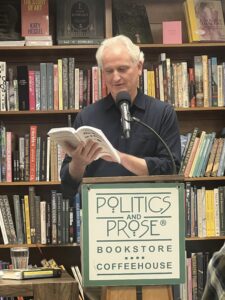
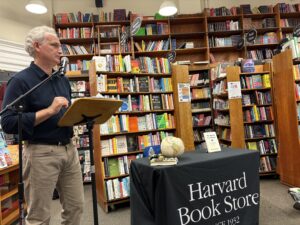
Attending a reading by Terrance Hayes at the Harvard Book Store the other day, I happened to sit next to Simon Constam. We happened to get to talking, and we happened to discover that we both write and read aphorisms. As Simon said, “the odds are astronomical against two people interested in aphorisms just happening to sit down beside each other.” So here, against the odds, is a selection of some of the aphorisms Simon subsequently shared with me, drawn from his manuscript-in-progress…

Exile is, like everything else, too much of a good thing.

Night after night all the things that do not change / Are startled by the changes that light brings.

Eventually you ignore the traffic, even the sirens, even the disturbances in the apartment next door. The classical guitarist cannot hear the squeaking of the strings.

Uncertainty disappears into habit.

Go and see what you don’t know is there.

Strength is the ability to forgive oneself for weakness.

When A Pear Is A Pair

Ambiguous figures and visual puns have long been a source of popular entertainment. In 1830s England, publishers came up with a printing technique that allowed them to create illustrations with double meanings. One view is seen when the image is illuminated from the front and a different view is seen when the image is illuminated from the back. During the same visit to Boston’s MFA at which I encountered Ian Hunter and M.C. Escher, I also came across The Pear, published around 1840 by T. Dawson, in which the pear/pair pun is charmingly visualized…

Visual puns like these are related to anamorphoses, images or projections whose full aspect can only be taken in from a single vantage point. Swiss artist Markus Raetz makes amusing anamorphoses, which you can see in this video of Yes-No (2003), a sculpture that displays the words “yes” or “no” depending on the position of the viewer.


Visual Wit and Ambiguous Figures

At the Boston MFA a few weeks back, I was delighted to discover some Mott the Hoople and Ian Hunter album covers—as well as an explanatory note from Ian Hunter himself—among the works in the show about M.C. Escher.

Hunter is an Escher fan and used images from his works for the first Mott album and his initial solo effort. Escher used ambiguity to create works of great visual wit; he was a master of the ‘ambiguous figure,’ an image that embodies a kind of visual paradox or that can be seen as two different things depending on the perspective of the viewer. (Ian Hunter himself is no slouch when it comes to wit. One of my favorite lyrics by him: “You’d be a ruin if looks could kill” from 23A Swan Hill.)

One of the most familiar ambiguous figures is a duck-rabbit illustration, which invites two distinct perceptions, both of which are correct but only one of which can be seen at a time. When seen as a rabbit, the face is turned to the right, with the long ears streaming out behind. When seen as a duck, the face is turned to the left, with the ears transformed into a half-opened bill. Other famous ambiguous figures include the shape of a vase created by faces gazing at one another, or a young lady coyly turned from the viewer who is also a hunched, craggy old woman.

There are also more recent ambiguous figures. In 1956, British psychiatrist Lionel Penrose collaborated with his mathematician son, Roger, to create the “Penrose stairs,” which seem to be ascending and descending simultaneously. Escher created a similar effect in Waterfall, made in 1961, in which a stream feeding a waterwheel and waterfall seems to be flowing upward and downward at the same time.

What is witty about ambiguous figures is that they force the viewer to do a double take, to think two different things while looking at a single image. In this sense they are like visual puns, which are used all the time in advertisements—because it’s a quick, efficient way to arrest a person’s attention.

An excellent visual pun can be found in this Land Rover advertisement, depicting two hippos up to their nostrils in a muddy water hole, with the car-maker’s Freelander model driving up behind them, its headlights and side-view mirrors echoing the shape of the hippos’ eyes and ears.

Which reminds me of another pun… What do you call a semi-aquatic mammal noted for its insincerity? A hippocrite.

Aphorisms by David Lazar

Delighted to welcome back Jim Finnegan, proprietor of the ursprache blog and author of the aphoristically amazing Tramp Freighter, to ‘All Aphorisms, All the Time’ with this guest post…

I would not skip the essays in David Lazar’s I’ll Be Your Mirror: Essays & Aphorisms (University of Nebraska Press, 2017). They’re great reading. But allow me to comment only on the last section of the book, the aphorisms.

They’re divided into two sections, “Rock, Paper, Scissors, God” and “Mothers, Etc.”  Let me start with the latter section, comprised of psychologically intense bursts of language. For example, “She had heard that blood was good for the skin, that Mother.” These short entries operate more like jagged fragments excerpted from a dark tale than as what we conventionally might term aphorisms. Of course, in the aphorism now, just as in poetry, anything is permitted, as the late Nicanor Parra says, “as long as you improve on the blank page.”

The ‘mother’ character of these aphoristic utterances hovers in a space between archetype and an actual person, which commends both their universality and their immediacy: ‘You can get addicted to a Mother, even if she isn’t your own.” It would be remiss not to mention the images of Heather Frise that disturb, in a good way, the pages of “Mothers, Etc.” Often sexually-charged and visually punning, one might say Frise’s images are Freudian slips between what Lazar has spoken.

Turning back to the first section, with its neat title, “Rock, Paper, Scissors, God,” we find a group of aphorisms that operate more in the vein of what we conventionally think of as aphorisms: “If my closets are full, where do I keep the skeletons?”

Walking is a theme Lazar works: “Is walking a form of public transportation?”

Even in this section Lazar’s aphorisms seem to be short stories distilled to one, maybe two lines; stories with a twist or coming at things from an oblique angle. Lazar sees the world differently: “The bliss in opening the door and finding no one there.” Or, “Even if you break your mirror and throw away most of the pieces, you can still see your eye, your fingers.”

A few more samples from David Lazar’s book…

From “Rock, Paper, Scissors, God”

When asked for my street address, I say, “I’m standing right here.”

There is nothing better than coming home, except for leaving home and staying away from home.

Our family crest was a nest of vipers.

Unless you write your epitaph, you never get the last word.

From “Mothers, Etc.”

Sometimes, out of nowhere, a Mother will love herself in a darkly consoling way.

Mothers freeze-dry our tears and sell them on the black market.

The Mother couldn’t help holding what she carried.

Mothers of Mothers know about places even all the other Mothers don’t know about.

Even More Aphorisms by Steven Carter

You may recall Steven Carter from earlier postings about his aphorisms, his parables and his oxymorons. He’s now published his Collected Aphorisms 2008-2018, which brings together a decade of mordant musings on art, life and everything in-between. The cover of Collected Aphorisms shows a picture of the ceiling beams in what was the library in the tower at Montaigne’s chateau in Dordogne, France. Montaigne had the beams inscribed with some of his favorite aphorisms from the Bible and by classical authors. Literally in the case of Montaigne’s library, and metaphorically in the case of this and other collections, aphorisms give us something to look up to. A selection from Steven Carter’s latest…

Much can be tolerated by condemning it.

People’s doubts reveal more about their spiritual strength than their beliefs.

Philosophy governs with the period, science with the exclamation point, literature with the question mark.

It’s easier not to be a phony than to be one.

Art is superfluous—which is precisely why it’s necessary.

A promise is like that fragile item in a glass shop—in reverse. If you break it, it owns you.

Aphorisms by Jack Mitchell

François de la Rochefoucauld (Geary’s Guide, pp. 131–134) cast a cynical, clinical eye on human vanity and personal weakness. Jack Mitchell, associate professor, Roman history at Dalhousie University, translates—literally and figuratively—the Duc’s devastating aphoristic observations for contemporary readers. The literal translation comes in Reflections, or Moral Opinions and Maxims: A Bilingual Edition, Mitchell’s rendering of Rochefoucauld’s Maxims in English; the figurative translation comes in D, or 500 Maxims, Aphorisms, & Reflections, Mitchell’s own aphorisms, which parallel the themes of the Duc’s rueful exploration of the human psyche. The books refresh Rochefoucauld’s voice and add Mitchell’s own to the grand tradition of the moral aphorism. A selection from Mitchell’s sayings…

The apocalypse is the easy way out.

Misers live for a moment that never arrives.

The wise suffer from an excess of moderation.

Life would not seem so short if we could remember it.

A reader’s library is his only true biography.

Sketches are the aphorism of the hand.

Only the studious discover what is not worth learning.

To learn, read; to know, reread.


More Aphorisms by Laurence Musgrove

I wrote about Laurence Musgrove—professor of, among other things, rhetoric and composition, creative writing (poetry), and visual thinking at Angelo State University in Texas—back in 2013, in connection with his witty, illustrated alter-ego, Tex. But behind every great wisecracking cartoon character is an animated human aphorist, and Musgrove is the source of memorable maxims even when they are not appearing in speech bubbles above Tex’s head. In his recent collection—One Kind of Recording: Aphorisms—he writes, “aphorists whittle sentences to a point.” Musgrove’s sentences are pointed and often poignant observations about life’s many inconspicuous yet decisive moments. A selection…

The signposts
to your life
are just up ahead
but mostly
behind you.

The more things you know
the more things remind you
of other things you know.

The best seat in the house
is sometimes outside.

From the bandwagon
it’s hard to see
everyone
you’re running over.

Take it or leave it
usually means take it.

The only way
to get anywhere
is to leave.

Age is when
the temporary
becomes permanent.

Close friends
know how to
keep their distance.

Apology admits
it should have
spoken up sooner.

Our lives depend
on those who
depend on us.

The aphorism
is a song
we’ve never heard
but recognize.

Aphorisms by Sharon Dolin

The epigraph at the start of Sharon Dolin‘s Manual for Living is from the Stoic philosopher Epictetus (Geary’s Guide, pp. 326–328) and reads:

Know first who you are, and then adorn yourself accordingly.

Roughly the first third of Dolin’s book riffs on and is inspired by Epictetus’s Encheiridion and Discourses, in which his observations and aphorisms were recorded by his friend and follower Arrian. Dolin takes an aphorism from Epictetus and uses it as the title for a poem centered around that saying, updating the Stoic stance towards the vagaries of life with contemporary relevance. In ‘Approach Life as If It Were a Banquet’, Dolin writes with Stoic brevity of the evanescence of all things…

Implore no more / for what is, is no more.

Epictetus followed the standard Stoic line that we are not masters of our own fate and that unhappiness results when we hold mistaken beliefs about what falls within our sphere of influence. Some things are up to us, he wrote, and some are not up to us. In the great drama of human life, Epictetus said:

What is yours is to play the assigned part well. But to choose it belongs to someone else.

In ‘Always Act Well the Part That Is Given You’, Dolin writes:

Rehearse / reluctance with vehemence. The wavering scene / unwaveringly.

In ‘Happiness Can Only Be Found Within’, Dolin matches Epictetus’s

A person’s master is someone who has power over what he wants or does not want, either to obtain it or take it away. Whoever wants to be free, therefore, let him not want or avoid anything that is up to others.

with

All honor, steady bliss / comes from the peerless pear you raise / to your own lips.

And, in ‘Pay No Attention to Things That Don’t Concern You’, Dolin braids a fresh thread onto the Epictetus line

No man is free who is not master of himself.

with her own

Give up on self-belief / you’ve got to seek / in crow’s feet / of another’s smile.

I had the pleasure of spending a day last April with Sharon and other aficionados at a one-day aphorism symposium in Hartford, CT, organized by Jim Finnegan, proprietor of the ursprache blog and genius loci of Tramp Freighter. (That’s us in the below pic.) Dolin read from Manual for Living and other aphoristic work that day, demonstrating her gift for deftly slipping Stoic wisdom into poems that succeed as both lyric and aphorism.

Aphorisms by Sarah Manguso

“I don’t read prose so much as root through it for sentences in need of rescue.” This is the first sentence in Sarah Manguso’s 2016 examination of the aphorism in Harper’s, ‘In Short: Thirty-six ways of looking at the aphorism,’ in which she also confesses she has “a thing for writers who deliver their work by the line, the epigram, the aperçu.” Manguso is one of those writers herself, as she demonstrates in her collection of aphorisms, 300 Arguments (Graywolf Press, 2017).

Manguso’s Harper’s essay is an aphoristic consideration of the aphorism as a literary form. In item #27 of ‘In Short’s’ 36-section sequence, she rejects the idea that the aphorism is a modern, Twitter-induced phenomenon and, as such, is evidence that our attention spans are contracting faster than matter at the edge of a black hole. “Please don’t try to convince me that my romance with concision follows from the way we experience reality now, in interrupted and interruptive increments,” she writes, “or that if I like short literature I should be on Twitter; or that my taste is merely a symptom of a pathological inability to focus or commit; or that since I have a child I no longer have the time to write at length. I have always loved concision.”

One of the aphorisms in Manguso’s essay about aphorisms is:

Brevity isn’t the soul of witlessness; shallowness is.

The aphorism is the oldest written art form on the planet. It is now and always has been a discipline and style of philosophical thought, not some psychic shortcut to drive-thru insights. Aphorisms are words without ends. As Marie von Ebner-Eschenbach (Geary’s Guide, pp. 116–118) put it,

An aphorism is the last link in a long chain of thought.

Manguso’s aphorisms are indeed ‘arguments’; i.e., they put forward a point of view, a position, from which readers can form their own chains of thought. The arguments in 300 Arguments are not the partisan bickering we’ve become accustomed to, but part of the writer’s process of working on, reasoning through, and figuring out that also catalyzes that same process in the reader. In so doing, Manguso’s aperçus fit Julien de Valckenaere’s (Geary’s Guide, pp. 61–62) definition of aphoristic excellence:

The shortest aphorism that makes you think the longest is the best.

A selection from 300 Arguments:

The first beautiful songs you hear tend to stay beautiful because better than beauty, which is everywhere, is the memory of first discovering beauty.

If you want to know someone’s secret, don’t ask a thing. Just listen.

Achieve a goal and suffer its loss.

The trouble with setting goals is that you’re constantly working toward what you used to want.

I grew up amid violently white winters and green summers and roaring autumns. Now, in a place without such seasons, I’m stuck in a waiting room with the TV on the same channel all day, and I’m never called in for my appointment.

Giving up hope and submitting to suffering looks the same as achieving total detachment and surpassing the Buddha but for one detail: the smile. Remember to smile.

Aphorisms by Evan Esar

Evan Esar, an anthologist and collector of jokes and quips, described himself as a ‘humorologist.’ “I am not interested in dull stuff like the psychology of laughter,” he is quoted as saying in his 1996 New York Times obituary. “I am interested in classifying humor, in the nature and evolution of humor. I am a man of science.” His scientific pursuit of humor led him to classify laughter as deriving from five categories: wordplay, caricature, blunders, wit and nonsense. In the introduction to 20,000 Quips & Quotes, he wrote: “Where there is insight in citation, or wisdom winged with wit, especially from the world of letters, I have quoted liberally. For a good epigram not only makes a point, but a point to ponder.” Esar’s own sayings offer plenty of points to ponder, here accompanied by related sayings from authors no doubt featured prominently in his collections…

Think twice before you speak, and then you may be able to say something more insulting than if you spoke right out at once.

Think once before you give, twice before you accept, and a thousand times before you ask. —Marie von Ebner-Eschenbach

Admiration: Our feeling of delight that another person resembles us.

Admiration, n. Our polite recognition of another’s resemblance to ourselves. —Ambrose Bierce

Success is the good fortune that comes from aspiration, desperation, perspiration,and inspiration.

Genius is one percent inspiration, ninety-nine percent perspiration. —Thomas Edison

Character is what you have left when you’ve lost everything you can lose.

Character is fate. —Heraclitus

Statistician: A man who believes figures don’t lie, but admits that under analysis some of them won’t stand up either.

Doubt everything at least once, even the proposition that twice two is four. —Georg Christoph Lichtenberg

An epigram is the marriage of wit, and wisdom; a wisecrack, their divorce.

There’s a hell of a distance between wisecracking and wit. Wit has truth in it; wisecracking is simply calisthenics with words. —Dorothy Parker