Not long ago, I was walking along Essex Road in Islington when I spotted a billboard with a big picture of Thierry Henry on it. He loomed over the street, arms crossed—cool, aloof, determined. I don’t remember now what Henry was hawking, probably sneakers or mobile phones or credit cards or something. What I do remember are the words emblazoned next to his face:
I hate to lose but I’m not afraid to fail.
As an advertisement, I suppose that billboard was a failure because I haven’t the faintest idea what Henry was selling. But as an aphorism—a short, smart, witty, philosophical saying—it was a huge success. That phrase has stuck in my mind ever since, an edgier version of the more old-fashioned maxim ‘It’s not whether you win or lose but how you play the game.’
You don’t hear the word ‘aphorism’ much these days but, as the Henry billboard shows, aphorisms are all around us. The aphorism is the oldest written art form on the planet. The Egyptians and the Chinese were at it more than five thousand years ago; the ancient Greek philosophers and Old Testament authors were also early practitioners. Buddha (“We are what we think”), Jesus (“If a blind person leads a blind person both of them will fall into a ditch”), and Muhammad (“Trust in Allah, but tether your camel first”) all did it—and we still do it, too.
Everyone has a favourite aphorism, whether it’s a refrain from a pop song, a passage from a novel, or something a friend or relative used to say. An elderly gentleman came up to me at a literary festival, jabbed his forefinger into my chest, and recited a line his grandmother always used in times of stress:
Keep your mind and your bowels open and you’ll be all right.
A woman, struggling with the competing demands of motherhood and career, shared a saying she found comforting and inspiring:
If you’re not living on the edge, you’re taking up too much space.
On a train headed out of London, I saw a teenager swaying down the aisle towards me. He had shoulder length hair, his face riveted by lines of studs and piercings. On his t-shirt, this proud declaration:
A weekend wasted is not a wasted weekend.
These are all aphorisms, pithy, simple sentences that deliver the short sharp shock of an old forgotten truth. We all need words of wisdom to live by, little sacred scriptures we carry around inside our heads. And it is this aphoristic instinct that motivates us to carve inscriptions onto monuments and tombstones, scrawl graffiti on the sides of buildings, and plaster bumper stickers on the tailgates of our cars. It’s the reason I’ve been obsessed by aphorisms since I was eight years old, and why I’ve organized a symposium on the subject under the auspices of the Institute of Philosophy at the University of London.
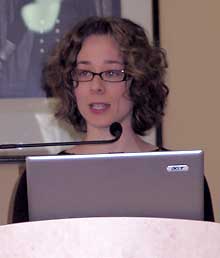
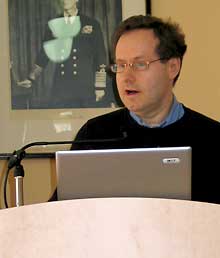
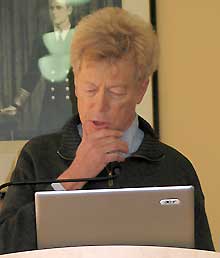
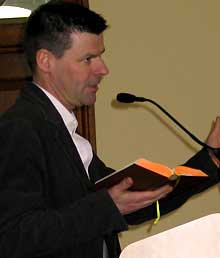
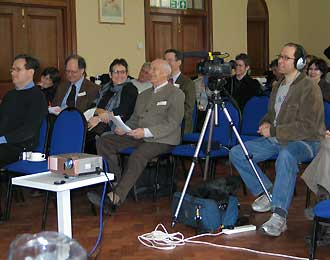
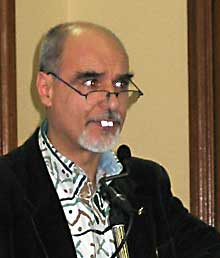
The symposium—The World in a Phrase: Philosophy and the Aphorism—will explore why, despite their antiquity, aphorisms remain the thinking and writing style best suited to our times. Poets, professors, philosophers, psychologists and comedians (all of them aphorists) from Europe and the United States will gather to discuss the aphorism as a bright, incisive way of grappling with the big questions of life—and to celebrate the form as just the thing if you hate ideologies but love ideas.
Why aphorisms? Because they cut the crap. They are cynical and acerbic, an antidote to the bland, relentlessly upbeat nostrums in self-help guides and inspirational literature. It’s not enough to just read one and murmur sagely to yourself, ‘How true, how true.’ Aphorisms make you want to do something. In our age of drive-thru culture, soporific sound bites and manufactured sentiment, they retain the power to instigate and inspire, enlighten and enrage, entertain and edify.
Aphorisms are literature’s hand luggage. They fit easily into the overhead compartment of your brain and contain everything you need to get through a rough day at the office or a dark night of the soul.
For John Lloyd, producer of television comedies like Not the Nine O’clock News, Spitting Image, Blackadder and QI, aphorisms are as valid and as useful statements about existence as mathematics or physics. “Like aphorisms,” he says, “key equations—e = mc2, for example—are super-pared down but immensely complex. They are the shortest possible expressions of interesting ideas.”
Lloyd also sees parallels between aphorisms and jokes, and will give a talk on that topic at the symposium. “If you’re miserable, the best thing to do is to have a laugh,” he says. “There is always something positive about the wisdom in aphorisms; jokes are not always that optimistic.” Lloyd cites a favourite line from American comedian Phyllis Diller:
We spend the first twelve months of our children’s lives teaching them to walk and talk and the next twelve years telling them to sit down and shut up.
Don Paterson, twice winner of the T.S. Eliot Prize for Poetry, was “infected” by aphorisms after reading Schopenhauer and Nietzsche as a teenager. He started taking an active interest after coming across the work E.M. Cioran, the Romania-born author of such charming, light-hearted sayings as:
The fact that life has no meaning is a reason to live—moreover, the only one.
“Aphorisms have to be wholly inspired,” says Paterson, who will attempt to come up with a working definition of the aphorism in his symposium talk. “If they are willed, they don’t work. If they don’t strike you as immediately and incontrovertibly the case, then who needs them? Aphorisms are a subversive form, and our times require subversion.”
It’s fitting that the symposium, the first of its kind with such an international scope, is held in London. A walk around the city is a miniature aphoristic history tour. Visit Samuel Johnson’s house on Gough Square near Fleet Street for the feel of the cafes and drinking establishments where the good doctor spouted lines like this:
The chains of habit are too weak to be felt until they are too strong to be broken.
A stroll through Soho will take you past some of the rooms where William Blake held séances, during which he executed quick sketches of the historical personages who came to visit (King Herod, Michelangelo, Socrates) and where he penned aphoristic verse like this:
If the fool would persist in his folly he would become wise.
Or make the pilgrimage to St. Michael’s Church in Highgate, where Samuel Taylor Coleridge is buried, just across the road from the house on The Grove where he made aphoristic quips like:
Painting is the intermediate somewhat between a thought and a thing.
And the city is still cranking out aphorists, like Les Coleman, an artist and author who lives in south London:
Puppets go to sleep the moment they break free from their strings.
My favourite London aphorist is Logan Pearsall Smith. An American, Smith lived almost his entire adult life in London, where he became a well-known essayist and critic and, in 1947, published the anthology, A Treasury of English Aphorisms. Smith is best remembered for the saying:
People say that life is the thing, but I prefer reading.
As much as I admire Smith, I can’t help but disagree with his aphorism. For me, literature is life, and aphorisms are literature/life distilled down to its very essence. The platitudes of politicians, the slogans of corporate salesmen, the bromides inside greeting cards—they’re all just Alka-Seltzer for the soul. They have a brief fizz, and may provide temporary relief from existential indigestion, but only aphorisms tell it like it really is.
A shorter version of this article originally appeared in Time Out London.
I perform my ‘juggling aphorisms’ show—real live juggling, with words and balls—on Thursday, March 13 at 6:30 p.m. at Waterstones on Gower Street.
The aphorism symposium takes place on Friday, March 14 in the Great Hall of London House at Goodenough College, Mecklenburgh Square. For information and tickets, go to the Institute of Philosophy website.