The past few weeks in The World in a Phrase

Here’s a round up of some of the interviews, talks, and articles that have appeared on The World in a Phrase over the past few weeks…

On the ePODstemology podcast, host Mark Fabian and I discussed how I go about conducting research on aphorisms and my year in the British Library compiling Geary’s Guide to the World’s Great Aphorists (3:37-6:00); Voltaire, the sacrament of confirmation, and doubt as a creative, fertile state of mind (25:37-27:50); the importance of a cross-cultural approach to aphorisms (30:50-35:44); the difference between aphorisms and haiku and abstract paintings (44:32-45:25); light verse as aphorisms (46:48-49:49); and Spinoza’s definition of love (56:00-57:38).

On The Literary Obsessive, host Eleanor Anstruther and I explored aphorisms as psychological circuit breakers and psychoactive substances.

On Bookbound on Dublin City FM, host Paul O’Doherty and I chatted about the 5 Laws of the Aphorism; Lao Tzu’s culinary and political advice; Muhammad’s counsel to camel owners; and Wittgenstein’s aphorisms about language. (15:44-28:16).

You can hear my talk at Politics and Prose in DC on the bookshop’s Politics and Prose Presents channel on Spotify.

And in The Atlantic, check out my essay Aphoristic intelligence beats artificial intelligence: It’s not just okay for some things in life to be hard—it’s essential.

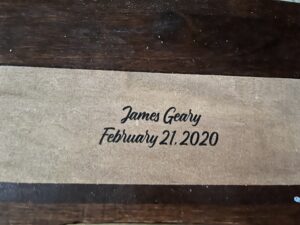
Plus, here’s a photograph of the bookmark I received from the great Tattered Cover Book Store in Denver

on the occasion of my Wit’s End talk there in February 2020, which fell out of my copy of Mark Z. Danielewski’s House of Leaves the other day…


Quotable Quotes and Points to Ponder

I took a spin through some back issues of Reader’s Digest, where I first discovered aphorisms, and was delighted (and surprised) by what I found. I sampled a few issues from the late 1960s and early 1970s, and I was reminded of the Points to Ponder recurring feature, a version of the Quotable Quotes page with slightly longer sayings.

One Point to Ponder quotes G.K. Chesterton defining in a single sentence the most important lesson he had learned in life:

The critical thing was whether one took things for granted or took them with gratitude.

Another Point to Ponder features Henry David Thoreau’s extended metaphor comparing arranging a fine life with arranging a fine fire:

When I am going out for an evening I arrange the fire in my stove so that I do not fail to find a good one when I return, though it would have engaged my frequent attention had I been present. Sometimes, when I know I am to be home, I make believe I may go out and I build my best fire. And this is the art of living, too — to leave our life in a condition to go alone, and not to require a constant supervision. We will then sit down serenely to live, as by the side of a stove.

Gotta love the old ads, too!

Joseph Pulitzer makes an appearance, with some excellent advice for writers in thinking about readers:

Put it before them briefly so they will read it, clearly so they will appreciate it, picturesquely so they will remember it and, above all, accurately so they will be guided by its light.

And the surprise was seeing Malcolm de Chazal on the Quotable Quotes page, one of the all-time great aphorists but not very well known, then or now. The editors at Reader’s Digest had some eclectic tastes…

Old age lives minutes slowly, hours quickly; childhood chews hours and swallows minutes.

Are You a Bromide? and the invention of the term ‘blurb’

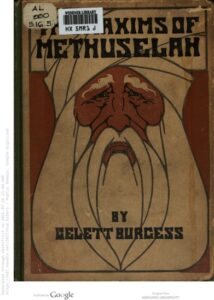
It was the title — Are You a Bromide? — that caught my attention. Potassium bromide is used in medicine as a sedative; literary bromides, anti-aphorisms, have the same effect. In this slim book, published in the early 1900s, author and humorist Gelett Burgess defines two types of people: the Bromide, who “does his thinking by syndicate… and may be depended upon to be trite, banal and arbitrary,” and the Sulphite, who “who does his own thinking … sees everything as if for the first time, and not through the blue glasses of convention.” The book was popular enough in its time to have gone through at least 11 printings, since I found a copy of the 11th edition in a bookshop in Jonesville, New York.

Burgess offers up sample “Bromidioms” — e.g., “I don’t know much about art but I know what I like” and “Of course, if you leave your umbrella at home it’s sure to rain” — but, alas, doesn’t offer up any sample Sulphidioms as a counterweight to the clichés. A couple he might have considered…

Art serves to rinse out our eyes. —Karl Kraus

A bank is a place where they lend you an umbrella in fair weather and ask for it back when it begins to rain. —author unknown

So, technically, the latter saying is a proverb not an aphorism, but it’s still nevertheless a Sulphidiom.

Burgess has some odd claims to fame. He is the author of “The Purple Cow: Reflections on a Mythic Beast Who’s Quite Remarkable, at Least,” which reads in full:

I never saw a purple cow

I never hope to see one;

But I can tell you, anyhow,

I’d rather see than be one!

He published two collections of “maxims” — The Maxims of Noah and The Maxims of Methuselah — both of which contain painfully sexist advice about relationships and neither of which consists of actual maxims.

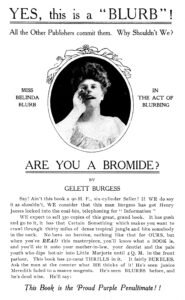
But, most amazingly to me, he invented the term ‘blurb.’ Burgess attributed the copy on the cover of Are You a Bromide? to one “Miss Belinda Blurb,” and included a photo of Miss Blurb “in the act of blurbing,” who commends this title to us because, among other reasons, “It has gush and go to it, it has that Certain Something which makes you want to crawl through thirty miles of dense tropical jungle and bite somebody in the neck.”

The best blurb ever, in my opinion, is by Ezra Pound and, though never intended to appear on any cover, it so accurately describes the contents of a great book:

The book should be a ball of light in the hands.


The World in A Phrase at the Harvard Kennedy School

Thanks to my colleagues in the Harvard Kennedy School’s Communications Program for inviting me to do a talk on political aphorisms. From the form’s beginnings in ancient China and Egypt, aphorisms have always been about governing — how to govern the self, the state, society. In Egypt, rulers like Ptah-Hotep set down collections of aphorisms to be used as moral instruction manuals for the sons who would inherit their kingdoms…

He that obeys becomes one obeyed.

In China, the I Ching is a book of governance, and in the Tao te Ching Lao Tzu has lots to say about how best to govern a country or community…

Ruling a large kingdom is like cooking a small fish; the less handled the better.

Muhammad ibn Zafar Al-Siqilli was known in his lifetime as “The Sicilian Wanderer” because he left his native Sicily to roam the Maghreb searching for an Arab prince who would put his political teachings into practice. He didn’t have much luck. After traveling back and forth between Sicily and northern Africa, al-Siqilli finally settled in Syria, where he died in poverty and without an official position. Al-Siqilli’s story has much in common with those of Confucius and Machiavelli: All three sought and failed to achieve influential positions at court, and both al-Siqilli and Confucius lived the latter parts of their lives as itinerant sages in search of like-minded monarchs. Al-Siqilli had some important insights about political policy makers and policy advisors…

Counsel is the mirror of the intellect. If, therefore, you would like to know the capacity of anyone, ask for their advice.

Madame De Staël was also a great political aphorist:

When one does not know how to convince, one oppresses

as was Audre Lorde:

In our world, divide and conquer must become define and empower.

One professional category is conspicuously underrepresented in the history of the political aphorism — politicians themselves. That is no doubt because aphorisms are too provocative and confrontational for campaigning, when candidates are likely to opt for poetry, then of course reverting to non-aphoristic prose for governing. Two notable exceptions are Benjamin Disraeli, who twice served as British Prime Minister and helped create the modern British Conservative Party (on becoming Prime Minister, he observed: “I have climbed to the top of the greasy pole”):

The palace is not safe when the cottage is not happy

and Adlai Stevenson, who lost both the 1952 and 1956 presidential elections to Dwight D. Eisenhower. Eisenhower, in fact, used to tease Stevenson about the witty aphorisms he included in his speeches, and Stevenson replied, “I refuse to conform to the Republican law of gravity.” Stevenson’s aphorisms are still wickedly smart and apt today:

The hardest thing about any political campaign is how to win without proving that you are unworthy of winning.

If the Republicans stop telling lies about us, we will stop telling the truth about them.

Sometimes in the deafening clamor of political salesmanship, I’ve thought that the people might be better served if a party purchased a half hour of radio and TV silence during which the audience would be asked to think quietly for themselves.

After a whirlwind tour of 5,000 years of political aphorisms, the HKS group went into aphorism-writing mode, penning some astute sayings of their own…

From the tomb of Troy came the cradle of Rome. —Muneeb Ata

Even the Ivy League grows weeds. —Alison Kommer

When you go far enough everything is on the way back. — Surbhi Bharadwaj

This past summer Surbhi and some of her friends began spontaneously composing aphorisms, including the one above, and recording them on video. The video shows the political nature of the aphorism in its purest form. The word ‘political’ comes from the Greek polites, meaning ‘citizen’, which in turn comes from polis, meaning ‘city-state’. Like politics, aphorisms pertain to public life and governance in three main ways:

  • They are a popular, grass-roots form — of the people, by the people, for the people — composed by citizens much more often than they are composed by political leaders
  • They are part of the tradition of persuasive rhetoric, like the shortest possible political policy memo, devised as solutions to shared problems, challenges, or opportunities
  • They are originally oral and often delivered in public, like the shortest possible political speech

Check out Surbhi and co.’s aphorism mash up vid below!

This week in The World in A Phrase III

Vladimir Putin is out with his latest annual calendar, which attempts to portray the Russian dictator in various manly, domestic, and statesmanlike settings. Each page of the calendar is accompanied by an attempt to portray the Russian dictator saying some vaguely manly, domestic, and statesmanlike thing, such as this oblique reference to Putin’s barbaric war against Ukraine: “Russia’s border never ends.” More accurate would be to accompany each picture with an aphorism from William Ralph Inge, dean of St. Paul’s Cathedral in London from 1911 until his death in 1954, such as these…

A man may build himself a throne of bayonets, but he can’t sit on it.

A nation is a society united by a delusion about its ancestry and by common hatred of its neighbors.

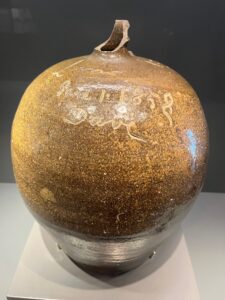
While at the Charleston Literary Festival, I visited the International African American Museum, located on the site of Gadsden’s Wharf, the arrival point in the U.S. for as many as 100,000 enslaved Africans. There I saw one of the stoneware jugs made by the enslaved potter David Drake. During the time Drake was at work in Edgefield, South Carolina, an area known for its stoneware, literacy was illegal for enslaved people. So it was a remarkable and dangerous act of defiance for him to write on his jars and jugs. He did it anyway, adding aphoristic couplets on moral, spiritual, and practical themes to his vessels.

Give me silver or; either gold

though they are dangerous; to our soul


I wonder where is all my relations

Friendship to all – and every nation

While in DC for a talk at Politics and Prose, I dropped by the Phillips Collection, where I sat in the Rothko room for a rumination and also spotted “Girl Writing” (1941) by Milton Avery, a poignant depiction of the composition process…


3 more podcasts featuring The World in A Phrase

Here are three more recent podcasts about all things aphoristic, with some conversation highlights indicated by time signatures… Once again I’m grateful for the chance to talk about The World in A Phrase on these wonderful podcasts and thank the hosts for their close readings and fun, provocative questions.

On The Spectator Book Club Podcast, the conversation with host Sam Leith covered everything from why aphorisms are like intellectual puzzles (3:24-5:34) to how aphorists stay lighthearted through dark humor (27:25-32:06) to key female aphorists in the history of the form (30:35-32:06)

On Lit with Charles, host Charles Pignal and I talked about What Walden means to me — and to the history of the aphorism — and why Henry David Thoreau is still relevant today

How James Joyce’s idea of the epiphany is related to aphorisms and how realizing Ulysses was funny helped me finally understand the book

Why some aphorisms work without words

On The Decision-Making Studio Podcast, with host Ben Cattaneo, we explored aphorisms as heuristic devices (9:21-14:09), aphorisms as decision-making manuals (20:22-24:32), aphorisms and improvisation via Wynton Marsalis (32:58-34:53), and what thinking aphoristically means to me (1:03:10-1:04:12)