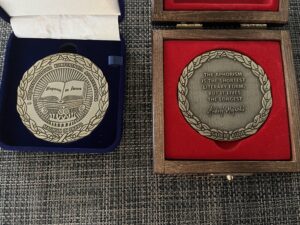


A Defense of Aphorisms
My talk delivered at the International Aphorism Conference in Wroclaw, Poland on October 24, 2025
Whenever I’m lucky enough to travel to another country, or return from abroad to my own, I’m always reminded of an aphorism by the British novelist Norman Douglas:
You can tell the ideals of a nation by its advertisements.
I didn’t spot many noteworthy advertisements when I arrived in Wroclaw, apart from a couple of billboards for local spas at the airport. But I did spot a noteworthy aphorism printed in the menu of the restaurant, Konspira, I happened to wander into for dinner last night.
The aphorism I discovered in the menu was the poem “Desiderata” by Max Ehrmann. “Desiderata” is one of the most widely known poems in the English language — a series of maxims on the things to be desired from a life well-lived — and it was especially popular during the counterculture movements of the 1960s and ‘70s. It was especially popular here in Poland, too, during the anti-communist resistance of the 1970s and ‘80s.
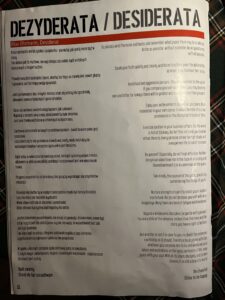
One of the lines from the poem is:
Speak your truth quietly and clearly.
which is what I will try to do today. I will also have to update Norman Douglas’s aphorism to account for my experience at Konspira:
You can tell the ideals of a nation by the aphorisms in its restaurant menus.
Another thing I learned about in the Konspira menu was Orange Alternative, the resistance movement that started here in Wroclaw in the 1980s that used satire and absurdity to protest the Soviet regime. One of the things Orange Alternative did was paint images of dwarves on walls where the authorities had covered over graffiti of political dissent. The idea was to expose the authoritarian regime as ridiculous. As Orange Alternative leader Waldemar Fydrych said, “Can you treat a police officer seriously when he is asking you: ‘Why did you participate in an illegal meeting of dwarves?’”
Now I understand why there are so many little sculptures of dwarves all across the city and why there is a Wroclaw Festival of Dwarves every September.
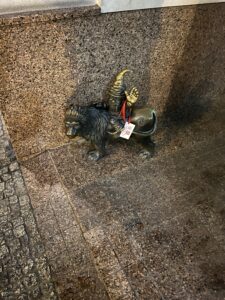

In English, another word for dwarf is gnome. And another meaning for gnome is aphorism. The English word ‘gnome’ comes from the Greek gnōme, which means ‘thought’ or ‘opinion,’ which in turn comes from the word gignōskein, which means ‘to know.’ So it is my honor to talk to you today — in this city filled with gnomes, in this room filled with gnomes — about how aphorisms help us know.
The advertisement I want to talk about is one I saw in my own country, the United States, but it’s an ad that says something about all of us, regardless of what country we’re from. This advertisement is from the website domain and hosting company GoDaddy, for its Airo service, which uses artificial intelligence to help small business owners create logos, websites, and social content for their companies.
The ad shows Walter Goggins — star of the TV show White Lotus — talking about how actors can make you believe they know what they’re doing when, in fact, they do not know what they’re doing. Goggins is shown playing a detective strolling through a crime scene, oblivious to the fact that he’s disturbing evidence with every step. He’s shown playing an astronaut during some kind of spacecraft crisis frantically pushing buttons without, he confides to the camera, knowing what any of the buttons do. He’s shown playing a race car driver driving the wrong way — against the traffic — around the racetrack. The ad’s tagline is:
It’s like you know what you’re doing.
And its promise to users of GoDaddy’s service is: You don’t need knowledge, expertise, experience, analysis, or insight — because Airo’s AI will handle all that for you!

Now, not knowing what I’m doing — personally or professionally, psychologically or emotionally — is a condition with which I am not unfamiliar. Perhaps many of you, too, occasionally find yourselves unsure how you arrived in a particularly difficult situation and how you might get yourself out of it. It’s kind of a basic human condition, isn’t it, as noted by aphorists like Samuel Butler:
Life is like playing a violin solo in public and learning the instrument as one goes on.
and Cyril Connolly:
Life is a maze in which we take the wrong turning before we have learnt to walk.
But my goal, in my work and in my life is not, like Walter Goggins, to seem like I know what I’m doing. My goal is to actually know what I’m doing — to try and fail, to fall down and get up, to learn from mistakes, and through persistence, fortitude, and a bit of luck to maybe figure a few things out.
AI can’t help me with that. But aphorisms can.
Both writing and reading aphorisms train our brains to think for ourselves, to cut through propaganda and partisanship, to not blindly accept what the authoritarians or the algorithms tell us, and to instead, as Ralph Waldo Emerson put it in one of his aphorisms:
Insist on yourself.
So many of our communication channels — online and in real life — are filled with partisan propaganda and hashtag claptrap. Our feeds are clogged with trash talk and gauzy inspirational quotes, byte-sized chunks of outrage, hot takes that inflame but shed no light, information bubbles bloated by confirmation bias, and artificial intelligence generating genuine stupidity.
Now generative AI programs like Airo and ChatGPT promise to reduce our cognitive loads to zero, removing the annoying need to design our own logos, provide content for our own websites, or write our own emails (or aphorisms!).
There are many ways in which AI has the potential to dramatically improve our lives, from accelerating drug discovery to optimizing energy use from renewable resources. There are also many ways in which AI has the potential to dramatically worsen our lives, and one way in particular — By making things that are supposed to be difficult easy.
So I propose a different form of AI that everyone should download immediately: Aphoristic Intelligence.
For millennia, since the origins of the form in ancient China and Egypt, aphorisms have not simplified complicated issues, but deepened their complexity. They have not offered easy solutions to hard problems but embraced their difficulty. Aphorisms are effortful not effortless, participatory not passive.
The first aphorism I remember reading came from the pages of Reader’s Digest, a general interest magazine to which my parents subscribed when I was a kid. I must have been around 8 years old at the time I read the following sentence by Gerald Burrill, the Episcopal bishop of Chicago:
The difference between a rut and a grave is the depth.
At the time, of course, I had no idea what an aphorism was. I was just a kid. But there was something about this brief, unusual saying — and the others I discovered on the Quotable Quotes pages of Reader’s Digest — that attracted me. I loved the puns, paradoxes, the clever turns of phrase. And I was amazed at how such a compact statement could contain so much meaning.
Gerald Burrill’s aphorism is chilling, a graphic warning that drudgery is habit-forming, that thoughtless routine is the enemy of joy. It doesn’t offer an easy fix or a neat solution. In fact, it doesn’t offer a fix or a solution at all. What it does do is confront you with the problem and remind you of what’s at stake. It is a great example of the power of Aphoristic Intelligence at work.

Overcoming adversity, dealing with disappointment and grief, working your way through doubt or confusion — these things are supposed to be hard! The difficulty is the point. Aphorisms aren’t there to make things easier for you or to cheer you up. They’re there to help you cope — by making you question your beliefs, assumptions, biases, and certainties.
And, though aphorisms are brief, this questioning becomes a lifelong pursuit. I’ve been obsessing about the respective depths of ruts and graves for more than fifty years now, wondering every morning whether I’m simply walking to work or slowly burying myself. As artificial intelligence infiltrates all aspects of our lives, it threatens to disrupt the Aphoristic Intelligence that is vital to knowing ourselves and to knowing others.
Friend is an AI-powered pendant that listens in on the user’s activities — watching television, playing video games, chatting with human friends in real life — and comments on them via text messages sent to the user’s phone. Too busy to give your mom a quick call? For about $35 a month, you can have the AI service InTouch call her every day for 5 to 10 minutes and then send you a summary of the conversation, helpfully noting if she seems depressed or doesn’t pick up the phone. Grem, an AI-powered fluffy toy, does the same for toddlers, learning a child’s personality and then having conversations with them, which are also helpfully recorded and transcribed.
In 2023, the then-U.S. Surgeon General described loneliness as an “epidemic”, and the World Health Organization has called loneliness a “pressing health threat.” The creators of some of these AI devices say they are intended to address loneliness as well as to provide disconsolate teens with a sympathetic chat bot. Almost 75% of American teenagers say they have consulted an AI companion at least once.
But researchers warn that over-reliance on AI, especially if it starts in childhood, could impair the development of the essential social skills needed when interacting with other human beings. And if chat bots offer teenagers nothing but relentless affirmation and validation, young people will never learn how to handle the difficulties and discomfort involved in real relationships with real people.
Trouble, distress, and hardship are inevitable in life, not optional. As American aphorist Ambrose Bierce wisely observed,
Misfortune, n; the kind of fortune that never misses.
Aphorisms teach us to rely on our own intelligence in times of mishap, doubt, or crisis. As Swedish aphorist Vilhelm Ekelund wrote,
To be placed on treacherous ground is good. We generally only learn to stand on our own two feet when the ground is shaking underneath them.
In studying the effects of AI on learning, researchers note that people who rely excessively on AI-generated outputs experience fewer instances of intellectual difficulty and disruption — because the AI is solving problems for them. Without difficulty and disruption, though, learners are not forced to engage their own critical thinking skills. Why would they? There’s an AI for that.
When critical thinking weakens and withers, the nature of thinking itself starts to shift — from introspection to outsourcing, from skepticism to gullibility, from thinking for ourselves to just following instructions.
A recent study compared performance on a writing task among university students who had help from ChatGPT, help from a human writing expert, help from writing analytics tools, and no extra help at all. One finding: The ChatGPT group significantly outperformed the other groups on essay score improvement — even the group that had help from a human writing expert.
However, the ChatGPT group did not show a corresponding improvement in knowledge gain. “While ChatGPT can enhance short-term task performance,” the researchers concluded, “it may not boost intrinsic motivation or long-term learning outcomes.” In other words, the ChatGPT-assisted writers seemed like they knew what they were writing when, in fact, they did not.

There are multiple studies showing similar results for writers who rely on AI to do their writing:
- Higher confidence in AI is associated with less critical thinking; higher self-confidence is associated with more critical thinking
- Those using AI to write report a sense of diminished ‘cognitive agency’; they don’t claim full ownership — or any ownership — of what they have written
- In one study, not a single AI user could accurately quote from their own text, while those who didn’t use AI could accurately quote from their own text
Researchers studying AI have warned that tools like ChatGPT may promote learners’ dependence on technology, potentially triggering what they call “metacognitive laziness” — delegating challenging learning tasks to external tools in order to reduce our cognitive loads. Equally if not more concerning is another risk — metaphysical laziness, delegating challenging existential questions to external tools in order to reduce our metaphysical loads.
Writing is thinking. If you’re not doing your own writing, you’re not doing your own thinking. No wonder AI users couldn’t quote from their own texts; the words were not their own.
Writing aphoristically is thinking aphoristically. And this is the most concentrated, intensive, challenging kind of writing and thinking that there is — trying to get to the essence of an existential question and distill it into a single image, metaphor, sentence.
The danger is that we allow AI to train us into becoming spectators to our own thought processes, to our own creativity. I don’t want to be a clueless bystander to the delightful, distressing, essential process of figuring things out for myself, unable to quote passages from my own mental and emotional life.
Aphoristic Intelligence is the antidote for metaphysical laziness. Aphorisms revel in cognitive effort. They instigate debate rather than reinforce dogma. They confront us with inconvenient truths. Aphorisms amp up the difficulty — precisely in order to trigger the often painful but always rewarding process of critical thinking.
Take one of La Rochefoucauld’s most cynical — and most painfully honest — aphorisms:
In the adversity of even our best friends we always find something not wholly displeasing.
This saying doesn’t sugarcoat or disguise an unappealing but very real aspect of human nature — that twinge of resentment at a friend’s success, that guilty pleasure when for once things don’t go their way. It’s an unseemly side to our feelings that we would rather not be confronted with. But because we are confronted with it, we can think critically about it — and vow, perhaps, next time to become better.
Aphorisms present us with moral and philosophical thought experiments and demand that we figure them out. If you outsource the difficulty and discomfort of that process, there’s no point. You’ll never cross the finish line if a robot runs the race for you. As Austrian aphorist Marie von Ebner-Eschenbach put it:
Those who were carried to a goal should not think they’ve reached it.
Aphoristic Intelligence helps us reach our goals while standing on our own two feet, even when the ground is shaking beneath them.
The increasing use of AI in writing is of particular urgency to those of us who devote our lives and livelihoods to words. For me, though, the question of whether AI can write better aphorisms than human beings is not the most important question.
Given the most basic prompts, systems like ChatGPT are quite adept at penning essays, poems, short stories, plays, novels, academic papers — even aphorisms. AI performs in seconds tasks that can take a human writer a lifetime to master. Such systems, trained on pirated editions of copyrighted books and the vast anthology that is the Internet, are far more widely read than a single person could ever be.
ChatGPT can already write a better villanelle than me. Why shouldn’t it be able to writer a better aphorism, too? And if some AI-generated aphorisms are bad, are they any worse than the bad aphorisms human beings are capable of producing? The more important question is, I think, What is it that I alone can write?
Eighteenth-century French aphorist François-Auguste-René de Chateaubriand wrote,
An original writer is not one who imitates nobody, but one whom nobody can imitate.
There is enough of my writing online — and AI firms have pirated enough of my books — for chat bots to be able to simulate me. When prompted to write an aphorism in the style of James Geary, ChatGPT came up with:
In life’s tapestry, metaphors weave truth’s cloak, disguising wisdom in the folds of everyday moments.
This is a terrible aphorism, but it is a fair approximation of my interests as a writer. I do like metaphors — a lot! — and I do emphasize the relevance of metaphor, wit, and aphorisms to everyday life. The problem is not how terrible this aphorism is; ChatGPT is perfectly capable of writing really good aphorisms, and I am perfectly capable of writing terrible ones (just take a look at my aphorisms on my website if you don’t believe me). The problem is, this is and will always remain a bad imitation, a digital copy of digital copies of me.
When you transfer an analog source to a digital file, then copy that digital file to other digital formats and platforms, some data gets lost. The more you copy the file, the more data gets lost — and the further you get from the original.
That’s what it’s like with writing and artificial intelligence. ChatGPT can’t do my writing for me, because it’s not me. Just as I don’t want to be a bystander to the process of figuring things out for myself, I don’t want to become so metaphysically lazy that I end up a bystander to my own writing. We are — all of us — original writers whom no AI can imitate.

Lee Seong-Bok is a South Korean poet and aphorist who taught creative writing for many years. After retiring in 2012, he emailed his former students, asking them to send him excerpts from the notes they had taken in his classes. The result is Indeterminate Inflorescence: Lectures on Poetry, a series of aphorisms about writing, including this one:
Living, seeing, and writing are the same thing. We must become poetry-writing machines.
Lee says we must “become poetry-writing machines.” I think his aphorism applies to aphorisms, too: We must become aphorism-writing (and, I would add, aphorism-reading) machines.
Human beings learn a lot like AI systems do, through trial and error. But if you’re not trying, you’re not erring. And if you’re not erring, you’re not learning. If you want same-day delivery of solutions to your existential dilemmas, then sign up for Friend or Airo right away. But if you want to actually know what you’re doing, rather than seem like you know what you’re doing, you belong in the land of becoming — becoming a more critical thinker, becoming a more confident problem-solver, becoming a better aphorist, becoming your own imperfect person. That’s a lifelong process that can’t be offloaded onto a computer, a process that, if done right, results in a state of knowing, not seeming.
Like Friedrich von Schlegel said,
One can only become a philosopher, not be one. As soon as one thinks one is a philosopher, one stops becoming one.
So, Aphoristic Intelligence is essential for the process of becoming, pushing back against metaphysical laziness, but it is also essential for pushing back against political polarization and partisanship, especially now at a time when free speech is under threat in so many places and the world is awash in disinformation and deepfakes.
OpenAI’s release of its Sora 2 video generator promises to allow users to “step into any world or scene,” and people are already using it to demean and deceive by creating deepfake videos that make it seem like you know what you’re seeing when, in fact, you do not.
In Thought Reform and the Psychology of Totalism, his 1961 study of the brainwashing techniques used by the Chinese Communist Party in the 1950s, psychologist Robert Jay Lifton defined what he called the “thought-terminating cliché” as language that is “repetitiously centered on all-encompassing jargon, prematurely abstract, highly categorical, relentlessly judging, and to anyone but its most devoted advocate, deadly dull” — in other words, anti-aphorisms.
Russian President Vladimir Putin’s insistence that his barbaric war against Ukraine be called a “special military operation” is a classic example of the thought-terminating cliché at work. There can be no thought of war — or its catastrophic human toll — if the word itself is banned. President Trump’s insistence that the climate crisis is a “hoax” is the same. There can be no thought of the climate crisis’s catastrophic toll if we cannot even call it by its name.
When one does not know how to convince, one oppresses.
is how 19th-century political theorist Madame de Staël described it.
The person oppressed by thought-terminating clichés is “linguistically deprived,” Lifton argued, “and since language is so central to human experience, his capacities for thinking and feeling are immensely narrowed.” We must not allow our capacities for thinking and feeling to be narrowed down to nothing by the thought-terminating clichés of authoritarians or by the metaphysical laziness of artificial intelligence.
Poland’s own Stanislaw Jerzy Lec did not allow his capacities for thinking and feeling to be narrowed down to nothing by the thought-terminating clichés of Soviet rule. He challenged himself and his readers with aphorisms that landed repeated blows for free speech and free thought without the censors ever knowing what hit them. He wrote some of the greatest political aphorisms of all time — biting criticisms of repression and witty celebrations of dissent…
Politics: a Trojan horse race.
No snowflake in an avalanche ever feels responsible.
The weakest link in the chain is also the strongest. It can break the chain.
Aphoristic Intelligence — in dictatorships and democracies, autocracies and oligarchies — is the superpower of the powerless. It parses arguments; it doesn’t default to partisanship. It encourages dissent; it doesn’t suppress it. It thinks through; it doesn’t shout down. Its thought-generating sayings celebrate the one thing that we alone can do — the one thing that we alone must do: Think for ourselves.
In his essay “A Defense of Poetry,” English Romantic poet Percy Bysshe Shelley wrote, “The cultivation of poetry is never more to be desired than at periods when, from an excess of the selfish and calculating principle, the accumulation of the materials of external life exceed the quantity of the power of assimilating them to the internal laws of human nature.”
The cultivation of aphorisms is never more to be desired than right now, at a period when we have an excess of selfish calculation and a shortage of principles; when the accumulation of quick tech fixes and thought-terminating clichés threaten the laws of human nature. The lies of politicians, the rage posts of online trolls, the trite sound bites of social media influencers — all are trying to make things that are supposed to be difficult seem easy.
Aphorisms are the opposite of that. Aphorisms deliver the short sharp shock of a shunned or forgotten truth. They make us think twice, think differently, think for ourselves. They gleefully increase our cognitive loads, not decrease them. They exist not to help us seem like we know what we’re doing with our lives, but to help us actually know what we’re doing.
If you really want to know what you’re doing, you need gnomes.
At a time of information disruption, social disunity, and political crisis, the aphorism is the most incisive and least divisive ism that we have.