

Fall for the Book
Video talk: Literature's Peak Experience: How Aphorisms Work
October 10 — Fairfax, VA
International Aphorism Conference
October 24-25 — Wroclaw, Poland
Harvard Book Store
November 10, 7pm — 1256 Massachusetts Ave, Cambridge, MA
Charleston Literary Festival
November 12, 10am — Charleston, SC
Politics and Prose
November 15, 3pm — 5015 Connecticut Avenue NW, Washington, DC
Mechanics' Hall
in collaboration with The Rabkin Foundation
November 18, 7pm — 519 Congress St., Portland, ME
Barnes & Noble Philadelphia
November 21, 6pm — 1708 Chestnut St., Philadelphia, PA
Hatchards, Piccadily
January 15, 2026, 6:30pm — 187 Piccadilly, London, UK
Iowa City Book Festival
October 2026 — Iowa City, IA
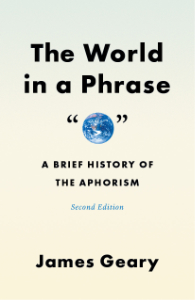
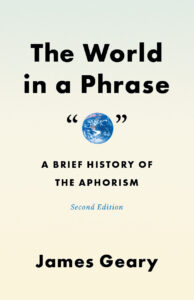
The World in a Phrase
A Brief History of the Aphorism - Second Edition
Celebrating the short, witty, philosophical phrases known as aphorisms, this delightful history is an entertaining tour through the wisest and wittiest sayings in the world.
Aphorisms are literature’s hand luggage. Light and compact, they contain everything you need to get through a rough day at the office or a dark night of the soul. Aphorisms, the oldest written art form on the planet, have been going viral for thousands of years, delivering the short, sharp shock of old forgotten truths. Today, visual artists are mixing pithy language with compelling imagery and using social media to take the form into the future. In a world of disinformation and deepfakes, aphorisms point to the power of fresh debate over tired dogma and inconvenient truths over comfortable lies.
Starting in ancient China and ending with contemporary meme-makers and street artists, The World in A Phrase tells the story of the aphorism through brief biographies of some of its greatest practitioners, from the Buddha, Nietzsche, and George Eliot to James Baldwin, Audre Lorde and David Byrne. The World in A Phrase is for lovers of words and seekers of wisdom. This new edition of the New York Times bestseller features 26 additional aphorists and explores the aphorism in the age of social media, showing why these short sentences are the ultimate deep dives in an era when TL;DR has become a cultural catchphrase.
Published by the University of Chicago Press on November 10!
Pre-order Now
Praise for The Original Edition
“Geary fell in love with aphorisms when, at 8, his eye wandered to the Quotable Quotes section of Reader’s Digest ... His attraction turned into a lifetime obsession, which he indulges to the fullest in ‘The World in a Phrase’, his entertaining love letter to the compact form.”
– New York Times
“Probably the definitive work on aphorisms, a love letter-cum-memoir disguised as a reference book ... fellow fanatics will be delighted.”
– Publishers Weekly
“It is impossible not to be swept along with Geary’s enthusiasm. He has illuminated some poignant observations of the significance of introspection.”
– The Times Literary Supplement
“What a pleasant, personal, thoughtful little book ... Geary’s account is full of wonderful aphorisms .... Delightful.”
– Booklist
Events
Upcoming Appearances
Video talk: Literature's Peak Experience: How Aphorisms Work
October 10, Fairfax, VA
International Aphorism Conference
October 24-25, Wroclaw, Poland
November 10, 7pm, 1256 Massachusetts Ave, Cambridge, MA
November 12, 10am, Charleston, SC
November 15, 3pm, 5015 Connecticut Avenue NW, Washington, DC
in collaboration with The Rabkin Foundation
November 18, 7pm, 519 Congress St., Portland, ME
November 21, 6pm, 1708 Chestnut St., Philadelphia, PA
January 15, 2026, 6:30pm, 187 Piccadilly, London, UK
October 2026, Iowa City, IA
The World in A Phrase at the Harvard Kennedy School
December 6, 2025
Thanks to my colleagues in the Harvard Kennedy School’s Communications Program for inviting me to do a talk on political aphorisms. From the form’s beginnings in ancient China and Egypt, aphorisms have always been about governing — how to govern the self, the state, society. In Egypt, rulers like Ptah-Hotep set down collections of aphorisms to be used as moral instruction manuals for the sons who would inherit their kingdoms...
He that obeys becomes one obeyed.
In China, the I Ching is a book of governance, and in the Tao te Ching Lao Tzu has lots to say about how best to govern a country or community…
Ruling a large kingdom is like cooking a small fish; the less handled the better.
Muhammad ibn Zafar Al-Siqilli was known in his lifetime as “The Sicilian Wanderer” because he left his native Sicily to roam the Maghreb searching for an Arab prince who would put his political teachings into practice. He didn’t have much luck. After traveling back and forth between Sicily and northern Africa, al-Siqilli finally settled in Syria, where he died in poverty and without an official position. Al-Siqilli’s story has much in common with those of Confucius and Machiavelli: All three sought and failed to achieve influential positions at court, and both al-Siqilli and Confucius lived the latter parts of their lives as itinerant sages in search of like-minded monarchs. Al-Siqilli had some important insights about political policy makers and policy advisors…
Counsel is the mirror of the intellect. If, therefore, you would like to know the capacity of anyone, ask for their advice.
Madame De Staël was also a great political aphorist:
When one does not know how to convince, one oppresses
as was Audre Lorde:
In our world, divide and conquer must become define and empower.
One professional category is conspicuously underrepresented in the history of the political aphorism — politicians themselves. That is no doubt because aphorisms are too provocative and confrontational for campaigning, when candidates are likely to opt for poetry, then of course reverting to non-aphoristic prose for governing. Two notable exceptions are Benjamin Disraeli, who twice served as British Prime Minister and helped create the modern British Conservative Party (on becoming Prime Minister, he observed: “I have climbed to the top of the greasy pole”):
The palace is not safe when the cottage is not happy
and Adlai Stevenson, who lost both the 1952 and 1956 presidential elections to Dwight D. Eisenhower. Eisenhower, in fact, used to tease Stevenson about the witty aphorisms he included in his speeches, and Stevenson replied, “I refuse to conform to the Republican law of gravity.” Stevenson’s aphorisms are still wickedly smart and apt today:
The hardest thing about any political campaign is how to win without proving that you are unworthy of winning.
If the Republicans stop telling lies about us, we will stop telling the truth about them.
Sometimes in the deafening clamor of political salesmanship, I’ve thought that the people might be better served if a party purchased a half hour of radio and TV silence during which the audience would be asked to think quietly for themselves.
After a whirlwind tour of 5,000 years of political aphorisms, the HKS group went into aphorism-writing mode, penning some astute sayings of their own…
From the tomb of Troy came the cradle of Rome. —Muneeb Ata
Even the Ivy League grows weeds. —Alison Kommer
When you go far enough everything is on the way back. — Surbhi Bharadwaj
This past summer Surbhi and some of her friends began spontaneously composing aphorisms, including the one above, and recording them on video. The video shows the political nature of the aphorism in its purest form. The word ‘political’ comes from the Greek polites, meaning ‘citizen’, which in turn comes from polis, meaning ‘city-state’. Like politics, aphorisms pertain to public life and governance in three main ways:
- They are a popular, grass-roots form — of the people, by the people, for the people — composed by citizens much more often than they are composed by political leaders
- They are part of the tradition of persuasive rhetoric, like the shortest possible political policy memo, devised as solutions to shared problems, challenges, or opportunities
- They are originally oral and often delivered in public, like the shortest possible political speech
Check out Surbhi and co.’s aphorism mash up vid below!
20250700 Emily + Surbhi Aphorisms
Books
-
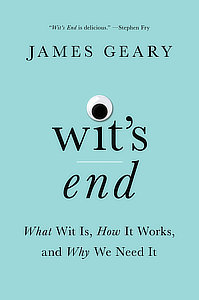
Wit's End
What Wit is, How it Works, and Why We Need It
Wit is often thought of as simply being funny. But wit is more than just having a knack for snappy comebacks. Wit is the quick, instinctive intelligence that allows us to think, say or do the right thing at the right time in the right place.
-
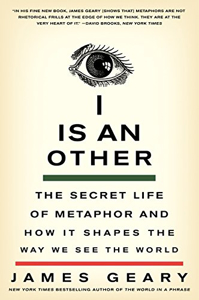
I Is an Other
The Secret Life of Metaphor and
How It Shapes the Way We See the WorldNew York Times bestselling author James Geary offers a fascinating look at metaphors and their influence in every aspect of our lives, from ordinary conversation and commercial messaging to news reports and political speeches.
-
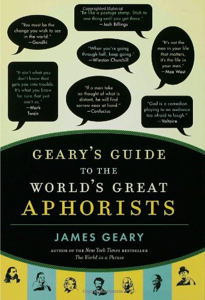
Geary's Guide to the
World's Great AphoristsGeary's Guide is the result of a lifetime's obsession with aphorisms and a year's death-defying research in the British Library. More than 350 authors from around the world, some of whom appear here in English for the first time, are brought together in this lively and thought-provoking compendium.
-
The World in a Phrase
A Brief History of the Aphorism - Second Edition
Celebrating the short, witty, philosophical phrases known as aphorisms, this delightful history is an entertaining tour through the wisest and wittiest sayings in the world. This new edition of the New York Times bestseller explores the aphorism in the age of social media, showing why these short sentences are the ultimate deep dives in an era when TL;DR has become a cultural catchphrase.
-
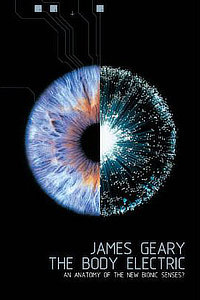
The Body Electric
An Anatomy Of The New Bionic Senses
Drawing on fields as diverse as artificial intelligence and neuroscience, The Body Electric provides an exciting synthesis of the people and technology making the convergence between biology and technology possible, while addressing the psychological, social and philosophical implications of these startling developments.